
Introduction to The Hermit Card
Let’s be honest: when The Hermit shows up in your tarot spread, your first instinct might be to panic. A solitary figure on a mountaintop holding a lantern? It sounds lonely, intimidating, maybe even a little depressing. But here’s the thing about The Hermit that most people get wrong: this isn’t about becoming a recluse or giving up on human connection entirely. It’s about something much more radical in our hyperconnected world. It’s about choosing yourself.
The Hermit sits at number nine in the Major Arcana, and it represents one of the most necessary yet underrated life skills: the ability to be alone with yourself without losing your mind. This card is basically your cosmic permission slip to stop asking everyone else what they think and start trusting what you already know. It’s about that moment when you realize that scrolling through advice columns and polling your group chat isn’t actually helping you make better decisions. Sometimes the only way forward is inward.
When The Hermit appears in your reading, it’s telling you that whatever you’re dealing with right now, the solution isn’t going to come from your boss, your therapist, your mother, or that friend who always seems to have her life together. It’s going to come from sitting quietly with yourself long enough to hear what your own voice sounds like underneath all the noise.
The Hermit Card Keywords
Upright: Soul-searching, intuition, independence, spiritual growth, solitude, self-discovery, inner truth, reflection, inner wisdom, meditation
Reversed: Avoidance, isolation, stubbornness, spiritual bypassing, loneliness, denial, resistance
The Hermit Card Upright Meaning
When The Hermit shows up right-side up in your reading, congratulations. You’re entering what we like to call your “inner wisdom era.” This is that phase of life where you finally stop caring so much about what everyone else thinks and start paying attention to what actually feels right for you. It’s not antisocial; it’s strategic.
The upright Hermit often appears when you’re facing one of those big life decisions that can’t be crowdsourced. Should you quit your job? End a relationship? Move across the country? These are the kinds of questions that require you to get really quiet and listen to that voice inside you that knows things before your logical brain catches up.
This card is especially relevant for anyone who’s spent years being the person everyone comes to for advice. You know the type: the friend who always has the perfect solution, the colleague who mediates every office drama, the family member who remembers everyone’s birthdays. The Hermit is telling you that it’s time to turn that wisdom inward for a while.
But here’s what makes The Hermit particularly interesting: it suggests that your period of going inward isn’t selfish. It’s actually preparation for being more genuinely helpful to others later. Think of it like those airplane safety instructions about putting on your own oxygen mask first. You can’t guide anyone else if you haven’t figured out your own path.
The upright Hermit is also about timing. In a culture that rewards quick decisions and instant gratification, this card is revolutionary in its insistence that some things simply cannot be rushed. The answers you’re looking for will come, but they’ll come on their own timeline, not yours. This card asks you to trust that process instead of forcing it.
The Hermit Card Reversed Meaning

The reversed Hermit is what happens when healthy solitude tips into something less productive. This isn’t about taking time to think; this is about hiding. And there’s a difference, even though they might look similar from the outside.
When The Hermit appears upside down, it often means you’re using isolation as a way to avoid dealing with reality rather than as a tool for understanding it better. Maybe you’ve convinced yourself that you’re “working on yourself,” but really you’re just avoiding the messy work of actually changing. Or perhaps you’ve become so committed to being independent that you refuse help even when you genuinely need it.
The reversed Hermit can also indicate that you’re stuck in analysis paralysis. You’ve been thinking about your situation for so long that you’ve lost the ability to actually make a decision. Sometimes the kindest thing you can do for yourself is to stop overthinking and just pick a direction, even if it’s not perfect.
Another common reversed Hermit situation: you’re sharing your “wisdom” before you’ve actually learned the lessons yourself. This is the spiritual equivalent of giving relationship advice when your own love life is a disaster. The reversed Hermit suggests that maybe it’s time to focus on your own growth before trying to enlighten everyone else.
There’s also a version of the reversed Hermit that’s about spiritual bypassing. This is when you use spiritual concepts or practices to avoid dealing with practical realities. Yes, meditation is wonderful, but it’s not going to pay your rent or fix your relationship problems. Sometimes earthly concerns require earthly solutions.
The Hermit Card Symbolism
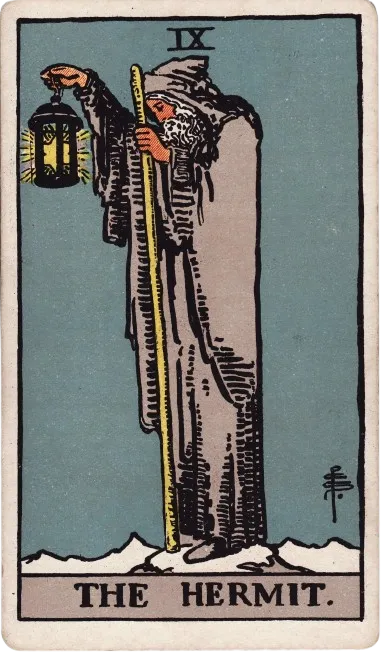
The traditional imagery of The Hermit card tells a story that’s worth understanding. You’ve got this elderly figure standing alone on a mountain peak, holding a lantern and leaning on a staff. Every element here is intentional.
The mountain represents perspective. When you’re dealing with day-to-day drama, everything feels massive and urgent. But when you step back and gain some elevation, you can see the bigger picture. The mountain also suggests that gaining wisdom requires effort. You don’t just stumble into enlightenment; you have to climb toward it.
The lantern is probably the most important symbol here. It contains a six-pointed star, which represents divine wisdom or spiritual insight. But notice that the light doesn’t illuminate everything around the hermit. It provides just enough light for the next step. This is how real wisdom works: it doesn’t give you all the answers at once, but it gives you what you need to move forward.
The staff represents the support system you build within yourself through experience. It’s not about depending on others; it’s about developing your own inner strength and stability. The hermit’s gray robes symbolize neutrality and the wisdom that comes from having seen enough of life to understand that most things aren’t as black and white as they initially appear.
The barren landscape isn’t meant to look depressing. It represents the stripping away of distractions that happens when you’re ready to focus on what really matters. Sometimes you have to remove the clutter to see clearly.
Historical Context & Archetype of The Hermit
The Hermit has been quietly minding his business in tarot decks since the Renaissance, and honestly, he hasn’t changed much. While other cards are busy with drama—chariots, towers, lovers—the Hermit is just… walking up a mountain with a lantern, taking his time. He’s traditionally tied to the number 9 in the Major Arcana, that liminal edge-of-completion energy where you’ve learned a lot, but you’re not quite done integrating it all. It’s the “I’ve seen some things” stage of the journey.
A lot of readers associate The Hermit with Virgo: detail-oriented, introspective, never not analyzing the situation to death—but in a useful way. Archetypally, he’s the wise elder, the monk, the mystic who steps away from the noise not because he hates people, but because he knows insight rarely shows up in a group chat. His lantern only illuminates a step or two ahead, which is kind of the whole point: this card doesn’t promise a five-year plan. Historically and symbolically, The Hermit stands in for sacred solitude, inner guidance, and the weirdly uncomfortable freedom of realizing no one else can walk your path for you.
The Hermit as a Person: Personality and Characteristics
If The Hermit were a person you knew, they’d be the one who Irish-exits the party without saying goodbye and then texts you three days later with a beautifully written paragraph about what they’ve been processing. They’re introspective, observant, and allergic to unnecessary chaos. They like people, they really do, but they need a buffer of alone time before and after any social interaction or they’ll short-circuit.
This is the friend who pays attention to what you’re not saying. They talk less than they listen, and when they do share an opinion, it’s been marinating for a while. The Hermit-type may seem distant or hard to read at first, but that’s usually just being careful, not cold. They take their time letting you in, but once they do, you’re really in the inner circle.
In love, they are steady and down-to-earth, not showy. They’d rather have a late-night conversation about purpose and fears than go to another loud event “just because.” At work, they gravitate toward roles where they can think deeply—research, writing, healing, spiritual work, analysis, mentoring Their superpower is perspective: while everyone else is reacting right away, The Hermit is quietly zooming out, making connections, and seeing the big picture.
The Hermit Card in a Love Reading
When The Hermit shows up in a love reading, it’s rarely telling you what you want to hear. If you’re single, this card isn’t promising that your soulmate is around the corner. Instead, it’s suggesting that maybe you’re single for a reason, and that reason might be worth exploring.
The upright Hermit in love readings often indicates that you’re in a phase where being alone is more important than being coupled. This doesn’t mean you’ll never find love; it means that the work you’re doing on yourself right now is preparing you to attract a different kind of relationship than the ones you’ve had before.
For people in relationships, The Hermit can indicate that both partners need space to grow individually. This isn’t about taking a break or seeing other people; it’s about creating room within the relationship for each person to maintain their individual identity. The healthiest relationships happen between two people who are comfortable being alone.
The reversed Hermit in love is more complicated. It might mean you’re isolating yourself because you’ve been hurt and you’re not ready to be vulnerable again. Or it could mean you’re using relationships to avoid being alone with yourself. Neither of these approaches tends to lead to the kind of love that actually lasts.
Sometimes the reversed Hermit indicates that you’re so focused on “working on yourself” that you’ve become unavailable to genuine connection. There’s a balance between healthy self-focus and cutting yourself off from love entirely.
The Hermit Card in a Career Reading
Professionally, The Hermit suggests that you’re entering a phase where your career decisions need to come from your own values rather than external expectations. This card often appears when you’re questioning whether your current job aligns with who you actually are versus who you thought you should be.
The upright Hermit is particularly relevant for anyone considering a career change that feels risky but authentic. Maybe you want to leave corporate law to become a yoga teacher, or quit your marketing job to write a novel. The Hermit says: trust your instincts, even if they don’t make sense to anyone else.
This card also favors careers that involve wisdom-sharing: teaching, counseling, writing, mentoring. If you’ve been thinking about transitioning into a role where your life experience becomes your professional asset, The Hermit is encouraging you to explore that direction.
The reversed Hermit at work often indicates that you’re either isolating yourself from opportunities or refusing guidance that could help your career. Maybe you’re so determined to figure everything out on your own that you’re missing chances to learn from people who’ve already walked your path.
The Hermit Card in a Yes No Reading
If you’re looking for a quick yes or no answer, The Hermit is going to frustrate you. This card doesn’t deal in simple answers because it represents situations that require nuanced thinking. When The Hermit appears in response to a yes/no question, it’s usually saying “not yet” or “you need more information.”
The upright Hermit suggests that whatever you’re asking about requires more contemplation before you’ll know the right answer. This isn’t the card of quick decisions; it’s the card of patient wisdom. If you’re trying to rush a decision that The Hermit is asking you to slow down and consider, you’re likely to make a choice you’ll regret later.
The reversed Hermit in yes/no readings often indicates that you already know the answer but you’re avoiding it because it’s not what you want to hear. Sometimes the wisest thing you can do is acknowledge what you already know to be true, even if it’s uncomfortable.
Spiritual Meaning of The Hermit Card
Spiritually, The Hermit represents one of the most radical concepts in our externally-focused world: the idea that you already contain everything you need to know. This doesn’t mean you should never learn from teachers or read books or seek guidance. It means that ultimately, your spiritual truth has to be discovered and verified through your own experience.
The Hermit’s spiritual journey is about developing discernment. In a world full of spiritual teachers, self-help gurus, and wellness influencers, how do you know what’s actually true and what’s just sophisticated marketing? The Hermit suggests that the answer lies in learning to trust your own spiritual instincts.
This card also speaks to the responsibility that comes with wisdom. As you develop genuine insight through your inner work, you naturally become someone others look to for guidance. But The Hermit reminds us that true spiritual teaching isn’t about having all the answers; it’s about helping others find their own.
The reversed Hermit spiritually often indicates spiritual bypassing or premature spiritual pride. This might look like using meditation to avoid dealing with practical problems, or becoming so attached to your spiritual insights that you stop learning and growing.
Cosmic Connections of the Hermit Card
The Hermit is associated with Virgo, which makes perfect sense when you think about it. Virgo energy is about careful analysis, attention to detail, and the pursuit of perfection through dedicated effort. This isn’t the flashy spiritual awakening of some other cards; this is the methodical, practical approach to wisdom.
As the ninth card in the Major Arcana, The Hermit carries the energy of completion and readiness to share what you’ve learned. Nine represents the end of a cycle and the wisdom that comes from having experienced the full journey.
The Earth element connection explains why The Hermit’s wisdom is so practical. This isn’t abstract spiritual theory; it’s wisdom that’s been tested in real life and found to be useful.
Questions to Ask When The Hermit Card Appears
When The Hermit appears, try sitting with these questions: What am I avoiding by staying busy and distracted? What would I do if I truly trusted my own judgment? What wisdom have I gained from my experiences that I’m not acknowledging? Where am I seeking external validation instead of trusting my inner knowing?
Also consider: How can I create more space for quiet reflection in my life? What beliefs am I holding onto that no longer serve me? Where might I be giving my power away to others instead of claiming my own authority?
Guided Action: Meditation & Affirmation for The Hermit
When The Hermit comes, it’s time to stop asking other people what to do and start paying attention to what you think. Do this: Sit somewhere quiet and imagine that you are holding the Hermit’s lantern. See a path in front of you, but let the light only reveal the next small step—not the whole journey. Notice any panic, control issues, or “but I need to know everything” energy that flares up. Breathe into it.
On each exhale, repeat: “I don’t need the full map to move forward.” Stay with that for a few minutes and just notice what ideas or feelings bubble up.
You can also work with this affirmation when The Hermit appears in a reading:
Affirmation: “My inner wisdom is enough for where I am right now.”
Write it on a sticky note, make it your lock screen, whisper it to yourself when you’re tempted to ask five different people what you should do. The Hermit is your reminder that the quiet voice inside you isn’t background noise—it’s the main guidance system.
Yes No Tarot’s Take
At Yes No Tarot, we take a soul-centered approach to tarot. We believe tarot is a tool to discover your own intuitive wisdom. This is our take on The Hermit Card: Sometimes the most revolutionary thing you can do is turn inward. The Hermit is calling your soul home to itself, away from the noise and opinions and endless distractions. This is sacred alone time. Use it to remember who you are when nobody’s watching, to reconnect with your own inner voice. The answers you’re seeking aren’t out there. They’re in here.
The Bottom Line
The Hermit card isn’t about becoming antisocial or cutting yourself off from the world. It’s about developing the kind of inner strength and wisdom that makes you more genuinely useful to yourself and others. In a culture that profits from your insecurity and confusion, choosing to trust your own inner guidance is a radical act.
The Hermit reminds us that the most important relationship you’ll ever have is the one with yourself. And like any relationship, it requires time, attention, and honest communication. The answers you’re seeking aren’t hiding in someone else’s Instagram story or self-help book. They’re waiting for you in the quiet moments when you’re brave enough to listen to your own voice.
Whether The Hermit appears upright or reversed, it’s asking you to take your inner life seriously. Not in a heavy, burdensome way, but with the kind of gentle curiosity you’d bring to getting to know a fascinating new friend. Because at the end of the day, that’s exactly what you’re doing.