
Introduction to The Emperor
Let’s talk about The Emperor card, because chances are, your first reaction to seeing this patriarchal figure might be an eye roll. Another authority figure telling you what to do? Not exactly what most of us are looking for these days. But here’s where tarot gets interesting and sometimes frustrating. The cards you think you want to avoid often carry exactly the message you need to hear.
The Emperor sits at number 4 in the Major Arcana, and he’s essentially the responsible friend of the tarot deck. You know this person. They remember to bring phone chargers on trips, actually read contracts before signing them, and somehow manage to coordinate group dinners without anyone having a meltdown about restaurant choices.
This isn’t about toxic masculinity or outdated power structures that make everyone want to quit their jobs and move to a commune. The Emperor represents something entirely different. He embodies healthy authority, the kind that protects rather than dominates. Think less “because I said so” and more “let me handle this complicated situation so you can focus on other things.”
What makes The Emperor fascinating is how he challenges our complicated relationship with power. Authority figures have disappointed us repeatedly. Leadership often means exploitation. Taking charge feels risky because we’ve witnessed too many people abuse their positions. The Emperor asks us to imagine something different.
He represents that rare person who steps into leadership not because they crave control, but because they genuinely want to improve situations for everyone involved. The colleague who volunteers to coordinate group projects not to micromanage, but because they know deadlines won’t be met otherwise. The friend who organizes birthday celebrations because they want people to feel valued, not because they need to be in charge.
Tarot readers consistently return to The Emperor when life feels chaotic, when boundaries have gotten blurry, when we need permission to take up space and make decisions. Sometimes we need reminders that structure isn’t the enemy of creativity or freedom. Sometimes we need to stop waiting for someone else to fix what’s clearly broken.
The Emperor challenges the false choice between being a doormat and being a tyrant. There’s a third option: competent leadership that serves collective interests rather than individual ego.
The Emperor Keywords
Upright: Authority, leadership, structure, discipline, control, stability, father figure, organization, protection
Reversed: Tyranny, rigidity, abuse of power, lack of discipline, weak leadership, domination, inflexibility
The Emperor Upright Meaning
When The Emperor appears upright, it’s like receiving a message from the universe saying “your moment has arrived.” This card shows up when you’re ready to stop complaining about how things work and start doing something about it.
This card appears constantly for people who’ve been quietly competent for years, waiting for someone to notice their capabilities. The Emperor says stop waiting. Friends keep asking for advice because the guidance they receive is valuable. Coworkers defer to judgment because that judgment proves sound repeatedly. The Emperor upright serves as cosmic permission to own those skills.
This isn’t about becoming dictatorial or steamrolling over everyone’s opinions. The Emperor’s authority stems from competence, not ego. When this card appears, it suggests the presence of skills and emotional intelligence needed to guide others effectively. People trust this kind of leadership because it’s been earned through consistent reliability.
The upright Emperor loves effective systems. While others reinvent solutions for recurring problems, The Emperor identifies what works and maintains it. Meal planning, budget tracking, organized calendars. These might sound mundane, but there’s something deeply satisfying about having life organized enough to actually enjoy spontaneity when it occurs.
Protection emerges as a major theme with this card. The Emperor upright often appears when someone is positioned to shield others from chaos. This might mean advocating for friends in difficult situations, providing financial stability for family members, or simply being the reliable person others count on when everything falls apart.
The Emperor also understands how to establish boundaries that actually stick. Not the dramatic announcements followed by complete abandonment of limits, but consistent boundaries maintained because they serve everyone better in the long run.
What’s compelling about The Emperor upright is how it reframes responsibility as empowerment rather than burden. Taking charge of situations that matter means no longer being at the mercy of other people’s poor planning, indecision, or incompetence.
The upright Emperor recognizes that sometimes the most caring thing you can do is make decisions that others find difficult to make themselves.
The Emperor Reversed Meaning
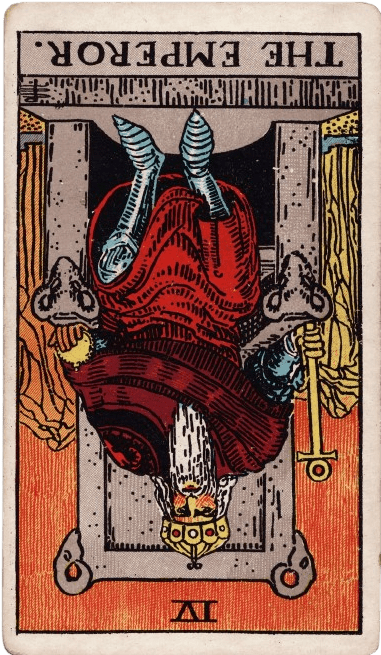
The Emperor reversed represents every frustrating authority figure anyone has ever encountered, and unfortunately, sometimes reflects behaviors we recognize in ourselves.
This card reversed points to power trips, micromanagement, and people who confuse having authority with being correct about everything. Everyone knows this person. They insist on controlling every aspect of group projects while contributing minimal actual work. They have strong opinions about how others should live but struggle to manage their own situations. They demand respect without earning it.
Sometimes The Emperor reversed appears when necessary leadership is being avoided because of fear of becoming that person. Perhaps there’s been too much exposure to power abuse, leading to an overcorrection where taking charge is refused even when situations desperately need someone to step up.
The reversed Emperor also represents rigidity that serves no one. Rules existing for their own sake. Procedures that made sense years ago but now create unnecessary obstacles. Managers who insist on return-to-office policies not because productivity improves, but because they need to feel in control.
This card frequently appears reversed for people struggling with self-discipline. The knowledge of what should be done exists, but maintaining routines or systems that would improve life proves difficult. The reversed Emperor might surface when adult responsibilities are being avoided, with hopes that someone else will handle difficult decisions or uncomfortable conversations.
Sometimes this indicates complete rebellion against all structure, including beneficial structure. Help gets refused because accepting it feels like admitting weakness. Commitments are avoided because they seem restrictive, even when those commitments would advance genuinely desired goals.
The reversed Emperor can also appear when family dynamics or workplace hierarchies become dysfunctional. Someone uses their position to control others rather than serve collective interests, creating toxic environments for everyone involved.
The Emperor Symbolism
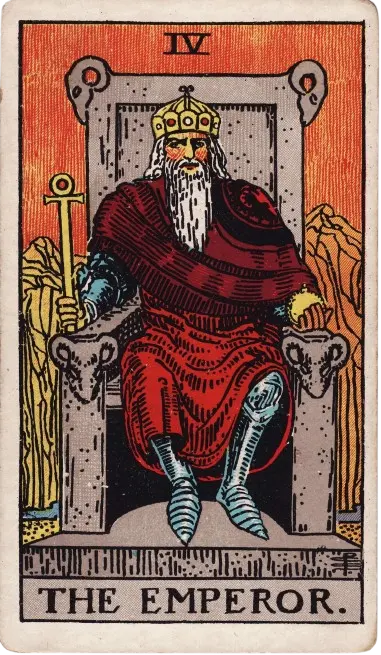
Traditional Emperor imagery tells a story about what legitimate authority actually looks like, which differs refreshingly from most real-world experiences with power.
His stone throne isn’t just dramatic decoration. Stone represents permanence, the kind of foundation that weathers storms and supports weight over extended periods. Ram heads decorating the throne connect to Aries energy, that pioneering spirit that creates paths others can follow.
The scepter topped with an ankh isn’t just ornamental. The ankh symbolizes life itself, suggesting that genuine power should nurture and sustain rather than dominate or exploit. His other hand holds an orb representing the world, indicating that effective leadership requires understanding how individual decisions affect larger systems.
Barren mountains behind him represent challenges that can’t be avoided or wished away. The Emperor doesn’t pretend difficulties don’t exist. He acknowledges obstacles as part of building anything worthwhile and prepares accordingly.
Red robes represent passion and energy, but armor underneath suggests that while The Emperor operates from genuine caring, he’s also prepared to protect what matters when necessary. The crown connects him to higher principles, indicating that true authority comes with accountability to something beyond personal preference.
Angular, geometric lines in The Emperor’s imagery deliberately contrast with The Empress’s flowing, organic forms. This represents different approaches to power and creation. Neither approach is superior, but they’re distinct in methodology and expression.
Historical Context & Archetype of The Emperor
Historically, The Emperor card has been “the builder” of the Major Arcana—the one who looks at The Fool’s chaos and says, all right, who’s in charge here? In early decks he’s the classic ruler on a throne, but tarot isn’t asking you to worship kings. That image is shorthand for structure, laws, and the unglamorous work of keeping things from falling apart. He’s the moment someone stops complaining about the system and quietly becomes the system that actually works.
Archetypally, The Emperor is linked to Aries and the number four: think four table legs, four walls, four corners of a map. Stable, grounded, meant to carry weight. Where The Empress is overflow and sensation, The Emperor is the blueprint, the schedule, the boundary line. Psychologically, he shows up when you realize there’s no “adultier adult” on the way and the job is yours now. In a reading, his energy isn’t “bow to your ruler” so much as “step into your own authority”—the part of you that can make hard, boring, necessary choices and still know you acted with integrity.
The Emperor as a Person: Personality and Characteristics
If The Emperor were in your phone, they’d be the person you text when a situation goes sideways. Their whole vibe is calm, capable, and slightly “designated parent friend.” They’re not trying to be glamorous; they’re trying to make sure everyone gets home. They’re the one who reads the contract, remembers the deadline, handles the group booking, and somehow knows where the nearest charger, pharmacy, or exit is at all times.
Emotionally, Emperor-type people can seem reserved at first, but their loyalty runs deep. Once you’re in, you’re under their protection field. They’ll help you fix your résumé, talk you through a breakup with actual action steps, or quietly transfer you money and refuse to let you spiral about it. At their best, they use power like a shield, not a weapon—setting clear boundaries, taking responsibility, and making the call no one else wants to make. At their worst, the same instincts harden into control issues: “my way or nothing,” rigid rules, or low-level panic if they’re not steering the ship. Underneath it, there’s usually one fear: if they don’t hold it together, everything might fall apart.
The Emperor in a Love Reading
The Emperor in love readings represents relationships that feel secure rather than just exciting. When this card appears upright, it often points to partnerships built on mutual respect, clear communication, and genuine commitment to supporting each other’s growth.
For single people, The Emperor suggests readiness for someone who has their situation together. Not someone perfect, because perfect people tend to be boring and probably hiding something important. But someone who follows through on plans, takes responsibility for mistakes, and offers genuine partnership rather than romantic drama.
Attraction might develop toward people who demonstrate reliability and emotional maturity. The person who responds to texts within reasonable timeframes, splits expenses fairly without prompting, remembers important work presentations and asks about outcomes.
For people already in relationships, The Emperor often appears when readiness exists to make concrete commitments or take practical steps toward shared goals. Moving in together, combining finances, adopting pets, having conversations about timelines and expectations. The unglamorous elements that actually determine relationship longevity.
The upright Emperor represents healthy masculine energy in relationships, regardless of anyone’s gender. It involves providing emotional security, sharing responsibilities equitably, and using whatever relationship power exists to support partners’ happiness and growth.
When The Emperor appears reversed in love readings, honest conversations about power dynamics become necessary. Someone might be using financial control, emotional manipulation, or other tactics to maintain dominance. This card encourages examining whether relationships feel balanced and supportive for both people.
The reversed Emperor can also indicate relationships where commitment and structure feel suffocating rather than supportive. Someone might focus so intensely on controlling outcomes that they prevent natural relationship evolution or stifle their partner’s independence.
The Emperor in a Career Reading
In career contexts, The Emperor often brings excellent news, especially for those waiting for recognition or advancement opportunities. This card suggests readiness for greater responsibility and indicates that others recognize the capacity to manage important projects or guide teams effectively.
The upright Emperor indicates career success through strategic planning, consistent effort, and willingness to make difficult decisions when necessary. The ability to organize complex situations and remain calm under pressure distinguishes individuals from colleagues who struggle with these professional requirements.
This card frequently appears for people considering entrepreneurial ventures or leadership transitions. The Emperor’s energy supports building sustainable enterprises rather than pursuing schemes based solely on optimism without practical foundations.
The Emperor often surfaces for people who’ve been quietly competent in current roles and are ready to step into positions where organizational skills and sound judgment can have broader impact. The card suggests others have noticed leadership potential, even when it hasn’t been fully acknowledged personally.
When The Emperor appears reversed in career readings, it often points to workplace conflicts with authority figures or problems created by rigid, ineffective management. This might involve dealing with micromanaging supervisors or working in environments where innovation is discouraged in favor of arbitrary procedures.
The reversed Emperor can also indicate avoidance of leadership opportunities or struggles with professional discipline. This card might appear when fear of responsibility or inadequate organizational systems limit career advancement.
The Emperor in a Yes No Reading
In yes no readings, The Emperor typically represents a strong yes, particularly for questions involving business decisions, leadership opportunities, and long-term planning. However, The Emperor’s yes comes with important conditions.
This isn’t the yes received for impulsive decisions or situations hoping for magical solutions. The Emperor’s affirmative response applies to questions where willingness exists to do actual work, develop concrete strategies, and accept responsibility for outcomes.
The upright Emperor supports taking charge and making definitive decisions based on careful consideration. His yes encourages moving forward with confidence, but only after homework has been completed and preparation made for likely challenges.
When The Emperor appears reversed in yes or no readings, the response shifts to “not yet” or suggests proceeding with significant caution. Power struggles, inadequate preparation, or authority conflicts might interfere with achieving desired outcomes. Addressing organizational issues or developing better systems may be necessary before moving forward.
Spiritual Meaning of The Emperor
Spiritually, The Emperor represents divine masculine energy that creates order and provides protection through disciplined service. This card teaches that spiritual authority comes from dedication to serving others’ highest good rather than seeking personal recognition or power.
The upright Emperor encourages taking responsibility for spiritual development by establishing consistent practices and structures that support genuine growth. This might mean committing to regular meditation schedules, engaging seriously with study programs, or accepting leadership roles in spiritual communities.
The Emperor reminds us that spiritual growth requires both inspiration and dedication. While mystical experiences and profound insights are valuable, lasting transformation comes through consistent practice, especially when motivation is lacking or progress feels slow.
What’s interesting about The Emperor’s spiritual significance is how it challenges the idea that structure and spirituality are incompatible. Some people resist spiritual disciplines because they seem restrictive, but The Emperor suggests that appropriate frameworks actually create more space for authentic spiritual experience.
When The Emperor appears reversed spiritually, it can indicate spiritual authoritarianism or misuse of spiritual knowledge to control others. It might suggest excessive rigidity in spiritual beliefs or using spiritual concepts to avoid responsibility for practical life matters.
The reversed Emperor can also represent rebellion against beneficial spiritual disciplines simply because they seem demanding. This card encourages finding balance between spiritual freedom and the structure needed for authentic development.

Cosmic Connections of the Emperor
Astrologically, The Emperor connects to Aries, governing leadership, initiative, and pioneering spirit. This astrological association reinforces themes of taking charge, making bold decisions, and having courage to establish new approaches and systems.
The Emperor carries the number four, representing stability, foundation, and material world manifestation. This number emphasizes The Emperor’s role in creating lasting structures and the importance of practical, grounded approaches to goal achievement.
The Emperor connects to the element of Fire, governing passion, energy, and the drive to create and achieve. This elemental association highlights connection to dynamic action, leadership energy, and the transformative power of disciplined will.
Questions to Ask When The Emperor Appears
When The Emperor appears in readings, consider these questions: “Where in life is there need for greater responsibility or more structure and leadership?” This helps identify areas where stronger boundaries or more decisive action might benefit everyone involved.
“How can whatever authority and influence exists be used to better serve others rather than just advance personal interests?” This inquiry connects with The Emperor’s highest expression as benevolent leadership.
“What aspects of life need more discipline and organization, and what concrete steps can be taken to create better systems?” This addresses The Emperor’s emphasis on practical structure and disciplined action.
“Is power being used responsibly, or is there either avoidance of necessary leadership or excessive control?” This question embodies The Emperor’s teaching about balanced, ethical use of authority and influence.
Guided Action: Meditation & Affirmation for The Emperor
To tap into The Emperor, try a quick grounding ritual. Sit with your feet on the floor and imagine your spine stacking tall, like bricks building a solid column. Picture yourself on a stone throne—not above anyone, just firmly in your own seat. In front of you, see your life laid out. Notice one area that feels messy, leaky, or totally unmanaged.
Ask yourself, “What would responsible leadership look like here today?” Let one small, doable action appear—a boundary, a plan, a call, a list. Then anchor it with this affirmation: “My power is steady and protective. I create structure that supports my freedom and the wellbeing of those I love.” Say it until your body believes it a tiny bit more than before.
Yes No Tarot’s Take
At Yes No Tarot, we take a heart-centered approach to tarot. We believe tarot is a tool to discover your own intuitive wisdom. This is our take on The Emperor: Time to step into your authority. Not the kind that dominates or controls, but the kind that protects what matters. The Emperor asks your soul to build something lasting, something that serves not just you but the people who count on you. This is about claiming your power without apology and using it with wisdom. You don’t need anyone’s permission to lead your own life.
The Bottom Line
The Emperor serves as a reminder that true leadership involves serving others’ best interests through disciplined action and responsible use of whatever authority exists. Whether appearing upright or reversed, this card challenges examination of relationships with power, structure, and responsibilities that come with influence.
The Emperor teaches that lasting achievements require patience, discipline, and willingness to make difficult decisions for long-term benefit. This card encourages balancing strength with compassion, authority with service, and structure with flexibility.
What’s most valuable about The Emperor is how it reframes power as service rather than domination. In a world where authority figures frequently disappoint, this card offers a vision of what leadership could look like when exercised with genuine care for collective wellbeing.
Ultimately, The Emperor reminds us that everyone has capacity for leadership and responsibility to create stability for those who depend on them. The key involves using power wisely, maintaining clear boundaries while remaining open to growth, and understanding that true authority comes from commitment to serving something greater than immediate personal desires.
The Emperor doesn’t ask anyone to become someone they’re not. Instead, he asks people to step fully into who they already are, to own competence, and to stop waiting for permission to make things better. Sometimes the most radical thing you can do is simply be reliable.