
So You Want to Learn Tarot Card Meanings? Here’s Your Essential Guide
There is a specific, undeniable vibe to the moment you decide to take tarot seriously. It usually happens around 11:00 PM on a Tuesday, possibly after a third glass of natural wine or a particularly confusing text from someone whose name is saved in your phone with a cautionary emoji. You realize that your internal monologue has reached a dead end, and you need a second opinion—one that doesn’t come from your group chat.
Let’s be honest: there’s something deliciously dramatic about shuffling a deck of 78 cards. It’s tactile, it’s aesthetic, and it feels like you’re finally doing something about your life that doesn’t involve a spreadsheet. Whether you’re a seasoned pro who can spot a reversed Emperor from across the room or someone who just bought their first deck because the artwork looked “witchy-chic” on Instagram, understanding the actual meanings behind these cards transforms the experience. It turns a moment of confused guesswork into a genuine revelation.
At Yes No Tarot, we’re over the idea that tarot is exclusively for people who live in velvet-draped parlors or that one friend who is way too into moon water. It’s a practical, if slightly chaotic, tool for self-reflection. It’s been helping people navigate the messy, unscripted reality of being alive for centuries. So, grab your favorite deck, clear some space on your bedside table, and let’s decode the cards everyone talks about but few truly understand.
Major Arcana: The VIPs of Your Tarot Deck
Think of the 22 Major Arcana cards as the A-list celebrities of your deck. These are the heavy hitters, the cards that make the room go quiet when they flip over. If your tarot reading were a prestige HBO drama, these cards would be the series regulars—the ones who get the most screen time and the complicated backstories.
The Major Arcana tells the story of “The Fool’s Journey.” It’s essentially the hero’s journey, but with more mystical imagery and significantly fewer Hollywood tropes. It starts with The Fool (Card 0, because we love a blank slate) and ends with The World (XXI). These cards represent the massive, non-negotiable phases we all go through: the spiritual awakenings, the identity crises, and the moments that fundamentally rebrand who we are.
When these cards show up, pay attention. They aren’t interested in whether you should buy the Prada loafers or if you should finally start that Substack (though, usually, the answer is yes). They are addressing the big stuff. They’re talking about your “Eras.” Are you in your Hermit era (introverted, seeking truth, probably wearing a lot of linen)? Or are you in your Tower era (everything is falling apart, but arguably for the best)?
Dive deeper into all 22 Major Arcana Cards:
- The Fool
- The Magician
- The High Priestess
- The Empress
- The Emperor
- The Hierophant
- The Lovers
- The Chariot
- Strength
- The Hermit
- Wheel of Fortune
- Justice
- The Hanged Man
- Death
- Temperance
- The Devil
- The Tower
- The Star
- The Moon
- The Sun
- Judgment
- The World
Minor Arcana: The Supporting Cast That Actually Runs the Show
While the Major Arcana gets the magazine covers, the 56 cards of the Minor Arcana are the assistants, the best friends, and the HR managers actually running your life. If the Major Arcana is the “Big Picture,” the Minor Arcana is the “Daily Grind.” They deal with the 9-to-5, the Hinge matches, the Sunday Scaries, and the question of whether or not you’re actually going to hit your savings goal this year.
The Minor Arcana is divided into four suits, each with its own specific brand of baggage and four Court Cards (Page, Knight, Queen, King) that usually represent the people in your life who are currently annoying or inspiring you.
- Cups: The emotional support friends of the deck.
- Wands: The ambitious overachievers with boundless (and sometimes misplaced) energy.
- Swords: The over-thinkers who mean well but occasionally cut a little too deep.
- Pentacles: The practical ones who always have emergency cash and a 5-year plan.
Never underestimate the wisdom of the supporting cast. Sometimes, you don’t need a spiritual awakening; you just need to know why your creative project is stalled.
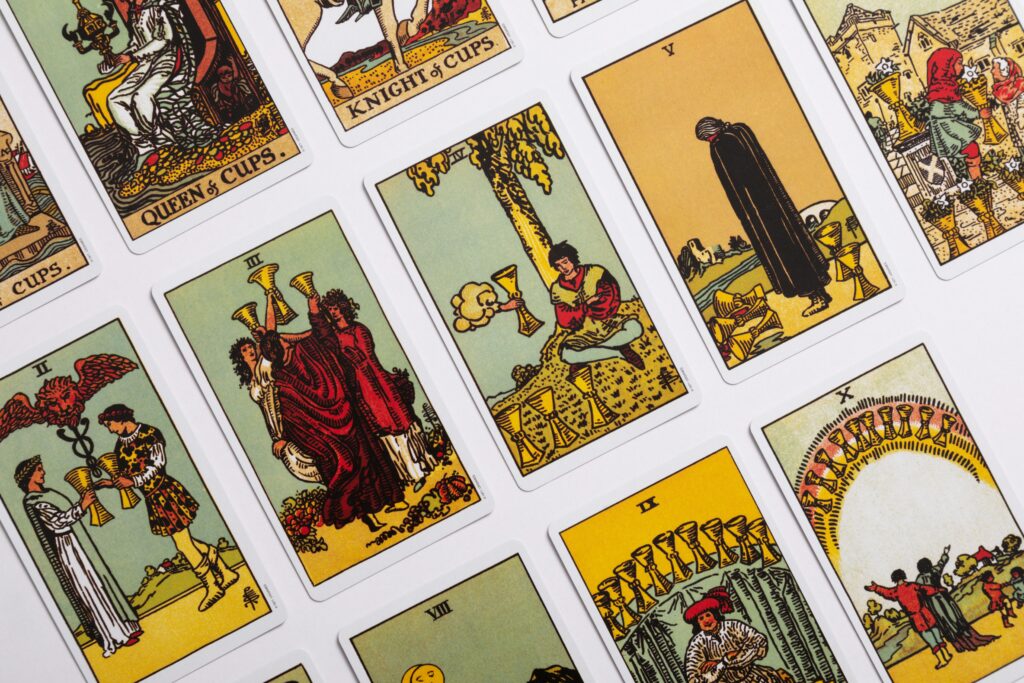
Suit of Cups: The Emotional Deep-Dive
Water signs, welcome to your natural habitat. The Suit of Cups is all about emotions, relationships, intuition, and those 2:00 AM feelings you only text to your “close friends” list on Instagram. When these cards dominate a reading, someone’s heart is definitely involved—whether it’s yours, your ex’s, or that person you’ve been “accidentally” running into at the gym.
The Ace of Cups is the emotional equivalent of popping a bottle of expensive champagne at a new beginning. It’s a flood of “new car smell” feelings. On the other end of the spectrum, the Ten of Cups represents that rare, elusive moment where everyone in your life is actually getting along.
In between, we have the messy stuff. The Five of Cups is the “mourning a situationship” card—you’re so focused on the three spilled cups that you don’t see the two perfectly good ones behind you. The Eight of Cups is the “walking away because I deserve better” card (very “thank u, next”).
The Court Cards in this suit are your emotional specialists. The Page of Cups is basically a teenager who just discovered poetry; the Knight is the romantic lead who might actually be a bit of a flake; the Queen is the empath who knows what you need before you do; and the King is the person who has finally learned how to have feelings without letting them run the entire show.
Suit of Wands: The Main Character Energy
Wands embody fire energy, which is exactly what it sounds like: passionate, creative, ambitious, and occasionally leaving a trail of scorched earth in their wake. These cards show up when you’re feeling inspired, when you’re making big moves, or when you need to check your ego before it writes checks your reality can’t cash.
The Ace of Wands is that spark of brilliant inspiration that hits you in the shower and makes you want to quit your job and move to Lisbon. The Three of Wands has big “looking out over your empire” energy—you’ve sent your ships out, and now you’re waiting for the ROI. The Seven of Wands is you defending your boundaries against people who are trying to steal your vibe.
The Court Cards here are the “doers.” The Page is bursting with ideas but lacks follow-through; the Knight is already halfway to the next adventure before finishing the first one; the Queen is the creative director who somehow manages five projects without smudging her eyeliner; and the King is the visionary who has built something substantial. When Wands fill your spread, it’s time to channel your inner Beyoncé. Create something, lead something, or at least bring some passion back to your routine.
Suit of Swords: The Intellectual Spiral
Air signs, you’ve found your people. The Suit of Swords cuts through confusion with intellectual clarity, though sometimes it cuts a bit too deep. These cards address mental activity, communication, conflict, and the stories we tell ourselves at 3:00 AM when we should definitely be sleeping.
The Ace of Swords is that moment of perfect clarity when you finally understand why that “friend” has been acting weird. But Swords aren’t always kind. The Three of Swords is the literal depiction of heartbreak—swords through a heart—and it hurts exactly as much as it looks. The Nine of Swords is the “Anxiety” card; it’s the mental prison we build for ourselves out of “what ifs.”
The Court Cards here are the thinkers. The Page is the perpetual student who won’t stop playing devil’s advocate; the Knight is the person who brings a knife to a vibe-check; the Queen is the one who sees through everyone’s nonsense but chooses her words with surgical precision; and the King is the intellectual authority who makes decisions based on logic, not “vibes.” When Swords dominate, it’s probably time to call your therapist or at least write your racing thoughts down so they’ll stop renting space in your head.
Suit of Pentacles: The Material World (And Its Consequences)
Earth signs, welcome home. The Suit of Pentacles grounds all that tarot mysticism in practical reality. This suit is about work, money, health, and the physical things you can actually touch. These cards appear when the universe thinks it’s time for a financial wellness check or when you need to stop overthinking your “purpose” and start paying attention to your posture.
The Ace of Pentacles is that job offer you’ve been manifesting, while the Ten represents the “old money” vibes we all aspire to. The Five of Pentacles is the “poverty consciousness” card—the feeling of being left out in the cold, even if help is right next to you. The Seven of Pentacles is the “waiting for the fruit to ripen” card; it’s about the patience required to build something real.
The Court Cards here are the managers. The Page is the intern who’s actually good at their job; the Knight is the one who plods along with a five-year plan; the Queen is the person who makes “practicality” look luxurious (she definitely has a linen closet); and the King is the mogul who has built enough security to be generous. If you see a lot of Pentacles, it’s time to look at your bank account, your LinkedIn, or that health issue you’ve been ignoring.
The “Scary” Cards: Why You Shouldn’t Throw Your Deck Across the Room
We need to talk about the cards that make people want to delete their browser history and start over. We’re talking about Death, The Devil, and The Tower. At Yes No Tarot, we don’t do fear-mongering; we do reframing.
When Death pops up, it rarely means a literal funeral. It’s more of a “thank u, next” from the universe. It means your current era has reached its natural expiration date. It’s the card of clearing out the closet so you can actually fit new clothes in it.
The Tower is the forced renovation. If you’ve been building your life on a shaky foundation—a job you hate, a relationship that’s “fine” but soul-crushing—The Tower is the lightning bolt that knocks it down so you can build something that actually passes inspection.
And The Devil? He’s usually just a call-out for your own self-sabotaging habits. He represents the things we’re “addicted” to—whether it’s a toxic person, a bad habit, or just the comfort of our own misery. These cards are like a blunt best friend: they’re telling you the truth because they want you to do better.
The Social Etiquette of Reading for Others
Now that you’re becoming the resident tarot expert, you will be tempted to pull your deck out at every dinner party. Word of advice: Ask first. Tarot can be surprisingly intimate, and not everyone wants their “internalized conflict” exposed over appetizers.
If you are reading for others, remember that you are the translator, not the judge. Your job isn’t to tell your friend her new flame is a “Page of Swords” (even if he definitely is); it’s to help her see the patterns for herself. And if the cards are being particularly mean? Maybe suggest a second glass of wine and a “clarity card” pull.
Also, a note on the “Vibe Check”: If you’re reading for a stranger and you feel like you’re hitting a wall, it’s okay to stop. Tarot is a two-way street; if the other person is closed off, the cards will be too.
Interpreting Cards: There’s No Right Answer (But There Are Definitely Wrong Ones)
Here’s the thing about tarot that most books won’t tell you: while there are traditional meanings, the most powerful readings happen when you blend that knowledge with your own intuition and the specific context of the question. That gorgeous guidebook that came with your cards? It’s a starting point, not a script.
Context changes everything. The Death card means something completely different when you’re asking about a career versus a relationship. The Three of Swords hits differently when it’s surrounded by hopeful cards versus more challenging ones. Sometimes, the most important information comes not from the traditional meaning but from that random detail in the card image—the way a bird is flying or the specific shade of yellow in the sky—that suddenly catches your eye.
As you develop your relationship with the cards, you’ll start noticing patterns. You’ll develop “inside jokes” with your deck. That’s not you doing it wrong; that’s you developing your unique reading style. The cards are having a conversation with your subconscious. Listen to it.
Upright vs. Reversed: Tarot’s Version of “It’s Complicated”
Some readers gasp at reversed cards like they’re bad omens, while others ignore them entirely. The truth, as usual, lies somewhere in the middle. Reversals add nuance. They are the “check engine” light of the tarot world.
Reversed cards typically suggest:
- Blocked energy: Something’s preventing the card’s full expression.
- Internalized energy: The card’s qualities are present but directed inward rather than outward. (e.g., The Queen of Pentacles reversed might mean you’re finally focusing on self-care instead of taking care of everyone else).
- Shadow aspects: The card is revealing unconscious patterns you’d rather not look at.
You can absolutely read without reversals and still get accurate insights. But if you’re ready to add some complexity, reversals offer a whole new vocabulary.
Creating Spreads That Actually Answer Your Question
Single card pulls are perfect for a morning “vibe check,” but sometimes life’s complications demand a more nuanced approach. That’s where spreads come in.
- Three-Card Spread: The Swiss Army knife of tarot. Past-present-future, situation-obstacle-advice, or “Him-Me-Us.”
- The Celtic Cross: The comprehensive 10-card spread that covers everything from your underlying influences to your hopes and fears. It’s detailed, but it can be overwhelming—like trying to watch a complex HBO drama while checking your phone.
- The Relationship Spread: Specifically designed to figure out why your “situationship” feels like a Three of Swords.
The key is defining what each position means before you draw the cards. Otherwise, your brain will conveniently reinterpret the positions to confirm exactly what you wanted to hear all along.
Developing Your Practice
We all know “That Tarot Person” who somehow manages to relate every conversation back to their latest reading. While their enthusiasm is admirable, you can develop a meaningful practice without making it your entire personality.
- Daily Card: Pull one each morning. It’s like having a mystical heads-up display for your day.
- Card Study: Choose one card weekly to research and observe in your life. It’s like becoming friends with each card individually.
- Reading Exchanges: Find a tarot buddy. They’ll catch the insights you miss because you’re too close to the situation.
- Integration: Journal your card pulls or photograph your favorite spreads.
Remember that becoming proficient at tarot is a marathon, not a sprint. Each confusing reading is actually building your skills. The cards are patient teachers if you stick with them.
The Aesthetics of Divination: Why Your Space Matters
Let’s be real: if you’re reading tarot on a cluttered coffee table next to a stack of unpaid bills and a half-eaten bagel, the “vibes” are going to be compromised. Creating a “Tarot Tableaux” isn’t just for the aesthetic (though it certainly helps the Instagram engagement); it’s about signaling to your brain that you’re shifting gears.
You don’t need a consecrated altar, but you do need intention. Clear a space. Maybe light some incense or a specific candle that you only use for “thinking.” The act of creating a designated environment helps quiet the noise of your Slack notifications and allows your intuition to actually speak up. Whether it’s a silk cloth or just a clean desk, give the cards—and yourself—some room to breathe.
Digital vs. Physical: Can an App Really Tell My Future?
Is pulling a digital card on your phone as valid as shuffling a $60 indie deck? The short answer: Yes. The long answer: It depends on your presence. The cards themselves are just ink and paper (or pixels and code). The magic—if we’re calling it that—is the bridge between the symbol and your brain.
A digital pull can be just as profound if you’re actually paying attention. However, there is something to be said for the tactile nature of physical cards. The way they wear over time, the “jumper” cards that fly out of the deck while you’re shuffling, the physical weight of them—all of that builds a relationship that an algorithm can’t quite replicate. Use the app for a quick check-in on the subway, but save the physical deck for the deep work.
Conclusion: Your Cards, Your Rules
Whether you’re pulled to tarot for spiritual guidance, psychological insight, or just because the artwork is objectively stunning, there’s no wrong way to engage with these symbols. The 78-card system offers endless combinations, ensuring you’ll never stop discovering new layers of meaning.
The most powerful tarot practice comes from balancing knowledge with intuition. Study the foundations, then allow your unique perspective to build upon them. Yes No Tarot reminds us that, ultimately, tarot is a tool for accessing your own inner wisdom. The cards don’t predict an unchangeable future; they illuminate possibilities. They’re the friends who tell you what you need to hear, not just what you want to hear.
As you continue exploring, remember that the future remains unwritten. The cards are simply offering the right questions to ask yourself as you navigate your own unique path. In a world of uncertainty, that’s more valuable than a concrete answer anyway.