
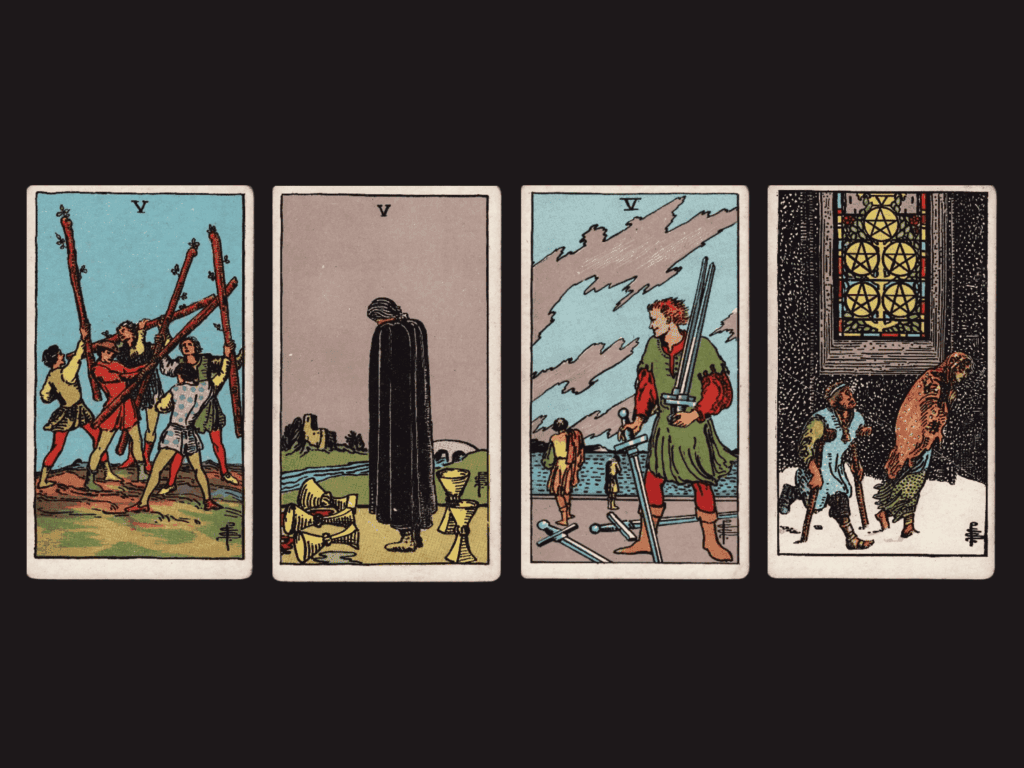
Look, we need to talk about the Fives in tarot. In the geometric, self-satisfied world of the Tarot’s Minor Arcana, the Fours are a nap. They are the four legs of a sturdy table, the four walls of a safe room—basically the “do not disturb” sign hanging on the soul’s door. But stability is often just a polite word for stagnation. Then come the Fives. If the Fours are a quiet Sunday morning, the Fives are the fire alarm going off at 3:00 a.m. because someone burnt the toast. They represent the “disruption factor,” that sudden, jarring realization that the floor you’re standing on is actually a trapdoor.
The Fives break the peace. They are the chaotic, high-voltage energy required to shatter a plateau that has become a prison. In a reading, these cards are notoriously prickly to see because they signal that the status quo has been unceremoniously evicted. Whether it’s a bruised ego, a light wallet, or a heavy heart, the Fives demand movement. They aren’t here to be comfortable; they’re here to make sure you don’t stay trapped in a version of yourself that has stopped growing.
The Role of the Number Five in Tarot
The Tarot number 5 significance is rooted in the messy, high-friction reality of being alive and having skin in the game. While even numbers offer the lullaby of symmetry, odd numbers introduce a third wheel—a point of tension that demands a resolution. The Five is the mid-point of the suit’s journey, the “mid-life crisis” of the deck. It is the bridge between the initial spark of the Ace and the eventual completion of the Ten, and like most bridges, it’s exposed to the wind.
Numerologically, Five is the number of the human experience. Five fingers, five senses, five points of the pentagram. It’s where the physical world hits the spiritual wall. In a spread, these cards scream that you are in the thick of it. You aren’t planning anymore (that was the Twos) and you aren’t celebrating yet (the Sixes). You are in the gritty, unglamorous middle where conflict in tarot is most prevalent. This instability isn’t a cosmic punishment; it’s a diagnostic tool showing you exactly where your current structure is too brittle to survive the next level.
Connection to the Major Arcana: The Hierophant (V)
To understand why the Minor Fives feel like a personal attack, we have to look at their spiritual patriarch: The Hierophant. As the fifth card of the Major Arcana, The Hierophant is the keeper of tradition, the social contract, and the search for external wisdom. When the chaos of a Five hits, our first instinct is usually to grab for a rulebook. We look for a mentor, a priest, or an HR manual to tell us how to fix the mess. We seek the safety of the “old ways” to navigate the new storm.
The Hierophant acts as a lighthouse during these times of crisis, reminding us that there are systems in place to handle the heat. When you find yourself drowning in the conflict of the Fives, this card suggests looking toward established structures or spiritual guidance for clarity. You can learn more about this figure of divine authority on our dedicated Hierophant meaning page. By connecting the Minor Fives back to the Hierophant, we see the struggle as a test of our beliefs—a push to find a higher perspective when the ground level is on fire.
The 5 of Swords: Winning the Battle, Losing the War
The 5 of Swords is the sharpest sting in the deck. The imagery is classic: a victor gathering up swords while others slink away in defeat. But look at his face. It’s not a look of triumph; it’s a look of hollow smugness. In the realm of the mind and communication, this Five represents the fallout of ego-driven conflict. It’s the moment you realize that being “right” feels incredibly lonely when you’ve burned every bridge to get there.
When this card pops up, it’s a warning against betrayal—usually of the self-sabotaging variety. It asks if the argument you’re currently obsessed with is worth the emotional casualties. Sometimes, the most powerful move is laying down your sword and just walking away. A victory gained through deception or cruelty is just a delayed defeat waiting to happen. You can explore the deeper, darker nuances of this complex card on our 5 of Swords guide. It’s a card for the ego to check itself before it wrecks itself.
The 5 of Wands: The Heat of Competition
If the 5 of Swords is a cold, calculated strike, the 5 of Wands meaning is a hot, sweaty scramble. This is the friction of competing ideas, petty bickering, and the struggle to be the loudest voice in a room full of screamers. Think of a brainstorming session where no one is listening, or a group chat that has gone completely off the rails. It’s “too many cooks,” where egos clash in a non-lethal but highly annoying way.
But here’s the thing: this card isn’t purely negative. It’s the testing of your skills. Just as athletes sharpen their game through competition, the 5 of Wands forces you to defend your position and prove your mettle. It’s an invitation to find your frequency amidst the static. For more on how to handle this fiery, frantic energy, check out our 5 of Wands analysis. Competition here is a catalyst for excellence, provided you don’t let the petty drama get under your skin.
The 5 of Pentacles: Feeling Left Out in the Cold
The 5 of Pentacles meaning hits where it hurts: the wallet and the ego. Visually, it’s bleak—two figures limping through the snow, passing a warm, lit window they can’t seem to enter. This is the card of financial dips, health scares, or the bone-deep feeling of being excluded. It’s the “hard times” card, highlighting exactly where you feel most vulnerable and unsupported in the material world. It’s a spiritual and physical winter.
The real tragedy here, though, is that the help is often right there—the lit window—but the figures are too busy looking at the ground to see the door. It warns against the “pauper mindset,” the belief that you have to suffer in silence or that scarcity is your permanent state. This card is a nudge to swallow your pride and reach for available resources. To dive deeper into the themes of resilience and recovery, visit our 5 of Pentacles page. The cold is temporary, but only if you’re willing to knock.
The 5 of Cups: Regret and the Spilled Cups
Emotional hangovers take center stage in the 5 of Cups meaning. This is the card of “if only.” We see a cloaked figure staring at three spilled cups, completely oblivious to the two full ones standing right behind them. It’s the quintessential crying-over-spilled-milk card, but the milk is actually your heart. It represents the heavy, suffocating fog of regret that prevents us from seeing the love and opportunity that still remain in our lives.
The lesson of the 5 of Cups is all about perspective. The loss is real, yes, and you’re allowed to mourn it, but staying in that mourning indefinitely is a choice to stay stuck. There is a bridge in the background of the card, symbolizing the way out. It reminds us that while we can’t un-spill the past, we can turn around and see the cups that are still full. You can read more about navigating this emotional transition on our 5 of Cups page.
Actionable Advice: When Fives Dominate a Reading
When your spread is drowning in Fives, the universe is telling you to pivot. A “Five-heavy” reading suggests your life is currently high-friction. You might feel like you’re playing Whac-A-Mole with your problems, or that every step forward is met with a slap in the face. The key is to stop fighting the friction and start looking for the heat it’s generating. Fives aren’t meant to be lived in; they are transit stations.
To get through this, you need radical acceptance. If you’re in a 5 of Wands situation, stop trying to win the argument and start observing the group dynamic. If it’s a 5 of Cups moment, grieve, but set a timer for when you’ll look at the remaining cups. You have to build resilience. According to the American Psychological Association, resilience involves maintaining flexibility and balance in your life as you deal with stressful circumstances and traumatic events. Treat the Fives as a training ground, not a dead end.
The Fives in a Yes/No Reading
In a “Yes/No” context, the Fives are almost always a “Temporary No.” Or, at the very least, a “Not like this.” Because Fives represent a state of flux and unresolved drama, the energy isn’t stable enough to support a solid “Yes.” If you’re asking about a new job and get the 5 of Pentacles, the answer isn’t “never,” it’s “not with this salary” or “not with this mindset.”
These cards are yellow lights. They are a call for adjustment. They suggest there is still work to be done, a conflict to be settled, or an emotional hurdle to jump before the path clears. Don’t be discouraged by a Five in a quick pull; use it as a prompt to ask the real question: “What do I need to change to make this a Yes?”
Conclusion
The Fives in Tarot are the necessary storms that clear out the stagnant air of the Fours. While they bring the undeniable sting of conflict in tarot, they also prevent us from rotting in our comfort zones. They challenge our brains, our passions, our bank accounts, and our hearts, forcing us to grow in ways a “perfect” life never could.
By understanding the sharp lessons of the 5 of Swords, Wands, Pentacles, and Cups, you can navigate life’s inevitable drama with a little more swagger. The chaos is just the midpoint. Once the lesson is learned, the equilibrium of the Sixes is waiting just around the corner to offer some much-needed peace and restoration.
