Introduction to the Five of Swords Tarot Card
The Five of Swords is the tarot card equivalent of slamming your laptop shut after a messy Slack thread and thinking, “Cool, I guess we’re all enemies now.” It lives in the suit of Swords, which is all mind-stuff: communication, truth, conflict, clarity, boundaries, the stories we tell ourselves, and the sharp little sentences we wish we could take back.
This card is rarely about a simple disagreement. It’s about the vibe after. The tension in the air. The feeling that someone “won,” but nobody actually feels good. The Five of Swords points to ego-driven battles, power dynamics, and that particular kind of conflict where being right becomes more important than being kind.
But it’s not here to scold you. It’s here to wake you up. It asks you to look at what conflict costs, not just what it gets you. Sometimes you do need to defend yourself. Sometimes you do need to draw a line. The Five of Swords just wants you to be honest about the method. Are you protecting your peace, or are you feeding your pride? There’s a difference, and your nervous system knows it.
Five of Swords Keywords
Upright: conflict, tension, betrayal, hollow victory, disagreements, selfishness, power struggles, harsh words, ego bruises, mind games
Reversed: reconciliation, moving on, forgiveness, lingering resentment, inner conflict, compromise, repair, learning to fight fair
Five of Swords Upright Meaning
When the Five of Swords appears upright, it often signals that conflict has happened, or it’s about to. This could be an argument, a falling out, a betrayal, or a situation where someone is determined to be “right” even if it burns everything down around them. If you’ve been in a conversation where you suddenly realize nobody is listening anymore and everyone is just loading their next point like a weapon, that’s Five of Swords territory.
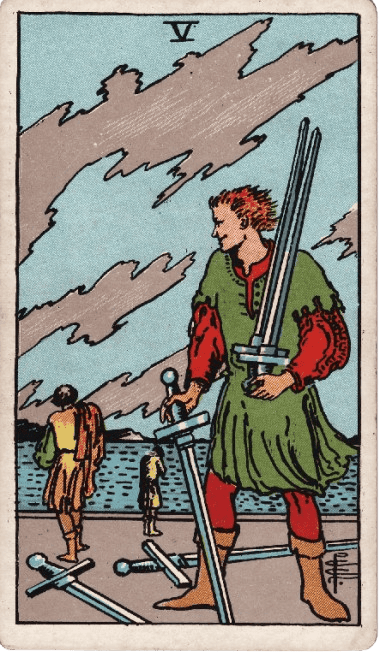
In the Rider-Waite-Smith deck, a central figure holds three swords while two others walk away, defeated. It’s a very specific kind of win: the kind that leaves you standing there with your prize, but also with a weird emptiness in your stomach. The card’s big theme is “winning at all costs,” and the uncomfortable truth that the cost is sometimes the relationship, the trust, or your own integrity.
Upright, the Five of Swords can show up when:
- Someone is playing dirty, twisting words, or trying to dominate the narrative.
- You’re caught in a power struggle where nobody wants to back down.
- You’ve said something sharp in the heat of the moment and now it’s echoing.
- You’re dealing with ego clashes, competitiveness, or a situation where respect feels thin.
There’s also a version of this card that is less villainous and more defensive. Sometimes it’s not that you want to “win,” it’s that you feel backed into a corner. You might be protecting yourself, your reputation, your boundaries, your sanity. The Five of Swords isn’t saying you should never stand up for yourself. It’s saying: choose your approach carefully. If you win by humiliating someone, you might get the outcome, but you’ll lose the atmosphere. You’ll lose the closeness. You’ll lose the part where people trust you enough to be real with you.
This card invites a hard but useful self-check: are you communicating with clarity and fairness, or are you trying to “land the blow”? Because the Five of Swords teaches a truth that’s annoyingly true in real life: victory without compassion is often a hollow one.
Five of Swords Reversed Meaning
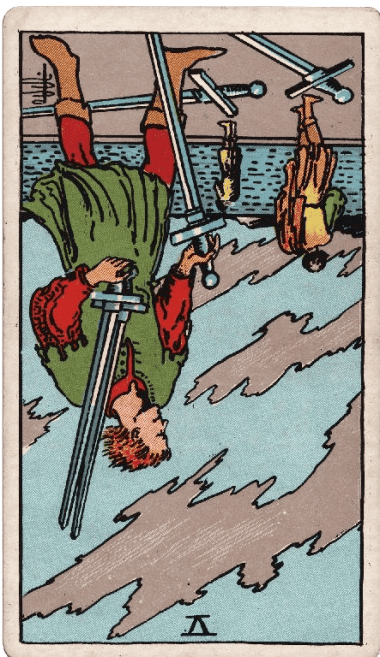
Reversed, the Five of Swords can feel like the emotional volume turning down. The fight is over, or you’re no longer willing to keep feeding it. This is the point where you might finally think, “I can’t do this anymore,” and for once, it’s not dramatic. It’s just honest.
In many readings, the reversed Five of Swords points to reconciliation, healing, and the aftermath of conflict. Apologies may be possible. Compromise may be on the table. You might be ready to rebuild a bridge, even if it’s a slow rebuild, even if the relationship looks different afterward. Sometimes the healing is mutual. Sometimes it’s you choosing peace without waiting for someone else to understand what they did.
This reversal can show up when:
- You’re ready to let go of being right and focus on being okay.
- A conflict is resolving, or at least softening, after a tense period.
- You’re learning to communicate without the need to “win.”
- You’re walking away from toxic competitiveness and choosing a healthier environment.
There’s also an internal layer here that matters. The reversed Five of Swords can point to inner conflict, harsh self-talk, guilt, and the kind of perfectionism that turns your brain into a courtroom where you’re always on trial. Peace is not only something you create with other people. Peace is something you practice inside your own head, too.
One caution: reversed doesn’t always mean “everything is fixed.” Sometimes it means avoidance. Sweeping things under the rug. Smiling through resentment. Saying “It’s fine” because you don’t want another fight, not because you actually feel fine. If that’s the case, the reversed Five of Swords becomes a gentle nudge: you don’t have to keep sparring, but you do deserve truth.
Ultimately, this reversal highlights lessons learned. It’s conflict with a chance of growth. It’s the part where you realize you don’t want to live in a battlefield, and you start choosing repair, maturity, and emotional adulthood over constant point-scoring.
Five of Swords Symbolism
The Rider-Waite-Smith Five of Swords is one of those images that feels like a whole short film in a single frame. There’s a central figure holding three swords, looking smug, while two people walk away, clearly done. Two more swords lie on the ground. It feels like things aren’t calm and the sky is cloudy, like after a fight that got out of hand.
A few details that matter:
- The swords represent ideas, speech, and how people talk to each other. The swords that the “winner” holds suggest that they have won, while the ones that fell suggest what they have lost.
- The central figure’s expression signals pride and ego, the kind of satisfaction that can curdle into loneliness.
- The defeated figures stand for emotional effects like hurt, anger, distance, and the choice to pull away.
- The stormy sky reflects mental turbulence, misunderstanding, and unresolved tension.
The whole scene carries one big message: you can claim victory and still lose something essential. Connection. Trust. Respect. The sense that things are safe. The Five of Swords is not just about conflict, it’s about what conflict leaves behind.
Five of Swords in a Love Reading
In love readings, the Five of Swords upright is a warning sign: arguments, power struggles, manipulation, or a dynamic where someone needs to be right more than they need to be loving. It can show up when fights turn into personal attacks. When one partner “wins” by making the other feel small. When your relationship starts feeling less like a safe place and more like a debate stage.
If you’re single, this card can suggest old hurts that still shape your approach to dating. Maybe you expect betrayal. Maybe you’re guarding your heart so hard you can’t actually let anyone in. Or maybe you’re attracting situations that mirror a pattern: people who want control, people who love winning, people who treat vulnerability like a weakness.
Reversed, the Five of Swords in love often points to reconciliation and repair. A willingness to talk things through. A moment where someone says, “I don’t want to fight like this,” and means it. It can also be the decision to stop reliving the conflict. To stop punishing each other. To move on, either together or separately, without dragging the resentment behind you like a suitcase.
This card asks a simple question that changes everything: are you trying to build intimacy, or are you trying to win? Love cannot thrive in a war zone. Even when you “win,” you lose warmth.
Five of Swords in a Career Reading
In career readings, the upright Five of Swords is workplace tension with teeth. It can point to competition that’s turned toxic, office politics, coworkers undermining each other, or leadership that rewards dominance instead of collaboration. Sometimes it’s a colleague who’s always trying to take credit. Sometimes it’s a boss who loves power more than people. Sometimes it’s a culture where everyone’s “just being direct,” but somehow it always feels like a slap.
This card can also be about your choices. You might be tempted to fight fire with fire. To outmaneuver someone. To play the same game they’re playing. And maybe you can. The Five of Swords just reminds you that a win gained through burn-the-bridge tactics can come back later as a reputation problem, a trust problem, or a “why does this job make me feel like a worse version of myself?” problem.
If you want a genuinely useful, real-world tool for navigating conflict without turning your work life into a gladiator arena, it helps to borrow a few conflict resolution strategies from negotiation experts:
Reversed, this card often signals resolution. A conflict may be settling. You might be negotiating a compromise, exiting a toxic job, or finding a healthier professional environment where collaboration is not treated like weakness. It can also mean that you are learning to stay out of power games, not because you are weak, but because you are smart enough to save your energy.
Five of Swords in a Financial Reading
In financial matters, the Five of Swords upright can signal disputes over money, risky decisions, or a short-term win that leads to long-term loss. Think: buying something out of spite. Taking a financial gamble to prove a point. Getting into an argument about shared expenses where the real issue is respect, not the numbers.
This card can also point to deals that look good but come with hidden costs. Fine print. Strings attached. A “win” that turns into stress later. The Five of Swords asks you to slow down and check motives. Are you making decisions based on what you know, or on your ego?
When you turn the card over, it shows that you can get better and make better choices. You might be moving on from a bad choice, settling a disagreement, or paying off a debt with more kindness than shame. Stop worrying about the money mistake and start making a better plan.
The financial lesson here is quietly powerful: stability comes from honesty and long-term thinking, not from “winning” in the moment.
Spiritual Meaning of the Five of Swords
Spiritually, the Five of Swords is ego work, plain and simple. Upright, it highlights the ways pride can drive conflict and disconnection. It’s the part of us that needs to be right, needs to be seen as the winner, needs to control how the story is told. Not because we’re monsters, but because being vulnerable is scary, and our egos often try to keep us safe by being sharp.
This card can also show you karmic lessons about how to set boundaries and talk to people. You might be learning when to speak up, when to walk away, and how to hold your truth without turning it into a weapon. It can show up when you’re tempted to “spiritually bypass” conflict, too, pretending you’re above it while quietly boiling inside. The Five of Swords is not impressed by performative peace.
Reversed, the spiritual meaning shifts into healing and release. Forgiveness becomes possible, not as a “be the bigger person” performance, but as a genuine act of freedom. You might be releasing grudges against others. You might be releasing cruelty toward yourself. The reversed Five of Swords reminds you that real strength is not domination. It’s integrity. It’s choosing unity where you can, and choosing distance where you must, without turning your heart into stone.
Cosmic Connections of the Five of Swords (Astrology, Numerology, Element)
Astrology: The Five of Swords is often linked to Venus in Aquarius, an interesting mix of relationship themes (Venus) and independence, ideals, and mental detachment (Aquarius). It can show conflict driven by values, individuality, and the desire to be “right” on principle.
Numerology: The number 5 represents change, instability, disruption, and challenge. It shakes things up. It forces growth. It often arrives in moments where you can’t keep pretending everything is fine.
Element: Air, which is the element of the Swords suit, is connected to thoughts, language, perception, and communication. The sky is cloudy and not calm, like how things feel after a fight that went too far.
Together, these correspondences emphasize mental challenges, conflict resolution, and the lessons that come when you’re forced to choose between ego and peace.
Questions to Ask When the Five of Swords Appears
- What am I trying to win, and what might I lose if I win this way?
- Am I prioritizing being right over being at peace?
- Where is pride driving this situation, mine or someone else’s?
- What would repair look like here, realistically?
- Is walking away avoidance, or self-respect?
- What do I need to release so I can move forward without resentment?
The Five of Swords in a Yes No Reading
In a Yes No reading, the Five of Swords is not a warm hug of a card. Upright, it usually leans no, or “yes, but it’ll come with drama.” The energy suggests conflict, fallout, or a situation where you can get what you want but you won’t like the price tag.
If you’re asking about a relationship, an ex, or a friendship that’s already tense, upright Five of Swords is a caution. It can indicate ego clashes, manipulation, or a dynamic where someone needs to win. If you’re asking about a work decision, it can point to politics, competition, or a deal that looks like a victory but leaves you isolated.
Reversed, the answer becomes more conditional. It can lean yes if the question is about making up, getting better, or moving on with maturity. But it’s not a yes without worry. Yes, but it means being responsible, communicating more clearly, and being ready to put down the swords.
A simple way to read it:
- Upright: No, or yes with emotional cost.
- Reversed: Cautious yes, especially if repair is possible.
This card wants you to choose the option that protects your dignity, not just your pride.
The Bottom Line
The Five of Swords is a blunt reminder that conflict has consequences. Upright, it highlights tension, disagreements, betrayal, and the dangers of ego-driven battles. It’s the card of hollow victory, the kind where you get the last word and still feel terrible afterward. It asks you to consider whether the energy you’re pouring into being right is actually building anything you want to live inside.
Reversed, the Five of Swords offers a way out: reconciliation, forgiveness, compromise, or the quiet power of moving on. It reminds you that peace is not weakness. Peace is strength with boundaries. Peace is knowing when to repair and when to walk away, without needing to scorch the earth first.
At its heart, this card teaches a grown-up kind of wisdom: you don’t have to win every battle to be safe. You don’t have to prove your worth through conflict. You can choose integrity. You can choose clarity. You can choose harmony. And sometimes, the bravest move is letting go of the sword entirely.