
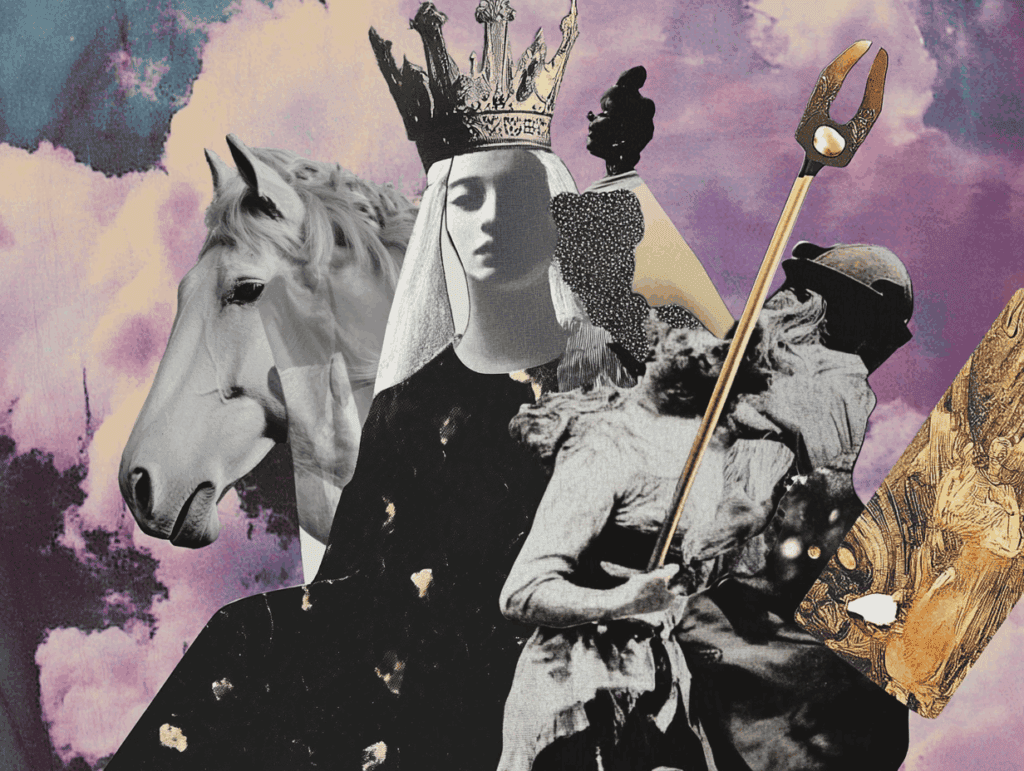
When it comes to Interpreting Tarot Court Cards, there is a very specific brand of psychic friction that happens during a tarot reading when you ask about your career and the Queen of Swords stares back at you. Immediately, the mental Rolodex starts spinning. Is she your boss? Your terrifyingly chic landlord? That one friend who always tells you the truth even when you specifically asked her to lie to you? We’ve been conditioned to view the 16 Court Cards as a literal cast of characters, complete with physical descriptions and moody temperaments.
But here is the thing: treating the Court as a “Who’s Who” of your social circle is incredibly limiting. In the context of a modern reading on YesNoTarot.com, the cards are rarely trying to introduce you to a stranger with “sandy blonde hair.” Most of the time, they are describing the “what” rather than the “who.” By shifting our perspective, we can begin seeing “Age” not as a biological fact, but as a metaphor for the developmental stage of a situation.
This shift is the ultimate glow-up for your accuracy. Instead of playing a high-stakes game of “Guess Who,” you start interpreting tarot court cards as situations with distinct lifespans. It allows you to gauge the maturity of an event, which is far more useful than wondering if a Page is actually your nephew or just a very persistent intern.
The Core Concept: Maturity Over Biology
In the world of tarot, “Age” has almost nothing to do with how many candles are on a birthday cake. Think of it more as the metabolic rate of the energy you’re dealing with. Is the situation a tiny, fragile sprout of an idea, or is it a fully grown oak tree with deep, stubborn roots? When we stop scanning the room for a physical person, we can start identifying the “Seed,” “Pursuit,” “Internalization,” and “Mastery” phases of our own lives.
A Page isn’t just a kid; it’s the infancy of a venture. A King isn’t just a patriarch; it’s the point where a situation has reached its peak manifestation and can no longer be easily moved. This is about the “lifespan” of a conflict or a project. To understand how these archetypes became such situational powerhouses, it helps to look at the historical structure of the tarot deck and how these ranks evolved beyond mere social status.
When you stop looking for a face and start looking for a pulse, the reading opens up. You begin to see where you are on the timeline of your own desires. To keep things simple, let’s look at how these ranks translate into actual situational “vibes” that you can apply to any spread.
| Rank | Developmental Stage | Situational Keyword | Maturity Level |
| Page | Infancy / Seed | New Message / Curiosity | Low Experience, High Potential |
| Knight | Adolescence / Pursuit | Movement / Momentum | High Energy, Very Unstable |
| Queen | Adulthood / Internalization | Strategy / Influence | High Emotional Intelligence |
| King | Elder / Mastery | Authority / Finality | Established / Non-Negotiable |
Pages: The “Infancy” of a Situation
A “Page situation” is essentially the spark of a “what if?” It’s that initial ping on your phone, a sudden burst of interest in a hobby you’ll probably abandon in three weeks, or a first draft written on a napkin. When you see a Page, think of it as the research and development phase of life. Everything is fresh, slightly clumsy, and incredibly light. There is very little “weight” to a Page situation—it hasn’t had time to grow a backbone yet.
In practice, this looks like receiving a job offer you aren’t sure about, a DM from a stranger, or the moment you decide to finally learn how to bake sourdough. If you’re asking about a project, the Page suggests you are in the “student” phase. You don’t have the answers, and honestly, you shouldn’t. This is the time for gathering data, not for making grand declarations.
In a Yes/No context, a Page is usually a “Yes, but you’re still a novice.” It’s an invitation to keep exploring, but it often carries a “Wait for more info” tag. The situation is still in its larval stage. It’s high on potential but low on actual substance. If you’re looking at the Suit of Wands guide, a Page might be that first hit of inspiration that hasn’t yet turned into a career.
The vibe here is purely experimental. It’s the “new relationship energy” before you’ve seen their messy apartment. It’s exciting precisely because nothing has been decided yet. Enjoy the lightness, but don’t expect the Page to carry a heavy load—they aren’t built for it.
Knights: The “Adolescence” of a Situation
If the Page is a spark, the Knight is the wildfire. This rank represents the “messy middle” of any event. An “adolescent” situation is characterized by incredible speed and very little direction. It’s that phase where you’ve committed to the bit, and now you’re dealing with the terrifying momentum of your own choices. It’s intense, it’s sweaty, and it’s usually quite loud.
Situational meanings for Knights are all about movement and extremes. Think of an urgent deadline that requires three pots of coffee, a sudden move across the country, or a passionate pursuit that feels like “main character energy” gone rogue. Knights don’t do subtle. They are about the “doing”—the raw, unrefined action that pushes a situation toward its peak.
When you’re asking a Yes/No question, a Knight is a “Yes, if you act right now.” It demands bravery and a bit of recklessness. However, it also serves as a warning to proceed with caution. Because Knights lack the wisdom of the older court cards, the energy is often erratic. You might get exactly what you wanted, but the “how” might be a total train wreck.
The vibe is undeniably high risk. If this appears in a reading about a relationship, it’s the whirlwind phase where you’re considering eloping after the second date. It’s movement for the sake of movement. It’s exhilarating, but it’s also exhausting because there is no “off” switch once the Knight starts riding.
Queens: The “Adult” Internalization of a Situation
As we move into the Queen’s territory, the energy shifts from outward chaos to inward mastery. This is where a situation matures and finds its center. It is no longer about the frantic chase of the Knight. Instead, a “Queen situation” is about “being” and managing the energy you have already built. This is the stage of emotional intelligence and sustainable growth.
Interpretations here focus on nurturing and behind-the-scenes influence. Think of a brand that has finally found its voice, or a long-term relationship that has moved past the drama and into a deep, soulful connection. It’s the point in a project where you stop obsessing over the logistics and start focusing on the long-term impact. You are no longer trying to get the thing; you are the thing.
In a Yes/No context, the Queen offers a “Yes, but focus on the ‘how’ and ‘why’ rather than just the ‘what’.” Success here comes through intuition. If you’re asking about a business, the Queen suggests the foundation is solid, and now you must lead with grace. Check out our Suit of Cups guide to see how this Queen-level energy manifests in emotional landscapes.
The vibe is stability. It’s the “CEO who actually knows how to do everyone’s job” energy. There is a quiet power here that doesn’t need to yell to be heard. It’s about managing your resources with a level of sophistication that only comes after surviving the Knight phase.
Kings: The “Grandmaster” Stage of a Situation
The King is the peak. When a situation reaches this stage, it has achieved its fullest manifestation. There is a sense of finality and establishment here. The King doesn’t need to run around (Knight) or even nurture (Queen) in the same way; the King simply exists as the law. This is the stage of legacy, authority, and firm boundaries.
Situational interpretations for Kings involve structures and long-term results. This could be a corporate hierarchy, a final legal verdict, or a long-term investment that is finally paying out. It’s the energy of “The End”—not as a tragedy, but as a completion of a cycle. The situation has reached its maximum maturity.
For Yes/No questions, a King is a firm “Yes,” but it comes with heavy responsibility. Conversely, it can be a “No” because the matter is already decided. The boundaries are set in stone. There is very little room for negotiation once a situation has reached this level of “King energy.” The matter is effectively closed.
The vibe is total control. If you see a King in a reading about your personal life, it suggests you have reached a point of absolute mastery over that area. You’ve done the work, you’ve survived the chaos, and you’ve managed the growth. Now, you are simply the authority on your own life.
Practical Tips: How to Swap “Who” for “What”
Transitioning to this situational method takes practice. The easiest way to start is by blending the rank with the suit. Instead of seeing a person, see a specific type of energy at a specific stage of its life. This allows for much more nuanced, “The Cut”-style observations about your life.
Take the Page of Pentacles. Instead of a “young student,” view it as a small, burgeoning financial opportunity—like the first $50 you made on a side hustle. Similarly, the Knight of Swords isn’t just a “rude guy”; it’s a situational energy of a rapid change of mind or a sharp conflict that clears the air.
When you flip a card, ask yourself: “What is the maturity level here?” Is this a “Knight of Wands” situation where things are moving fast and burning hot, (find more in our Suit of Wands guide) or is it a “King of Swords” situation where a final, logical decision has already been made and can’t be taken back?
By asking about the “maturity” of the event, you unlock a level of depth that “Who is he?” can never provide. You start to see the gears of your life turning, recognizing which situations need more time to cook and which ones are ready to be served.
Summary: Scaling Your Readings for Depth
Interpreting tarot court cards as situations is the quickest way to level up your practice. By viewing the “Age” of the Page, Knight, Queen, and King as a developmental scale, you move past the literal and into the energetic. You stop looking for people to blame or credit and start looking for the actual pulse of the events.
Whether you are navigating the “infancy” of a new Page-like idea or the “mastery” of a King-level achievement, this framework gives you a clear map. It turns the Court Cards from confusing neighbors into the most descriptive tools in your deck.
