
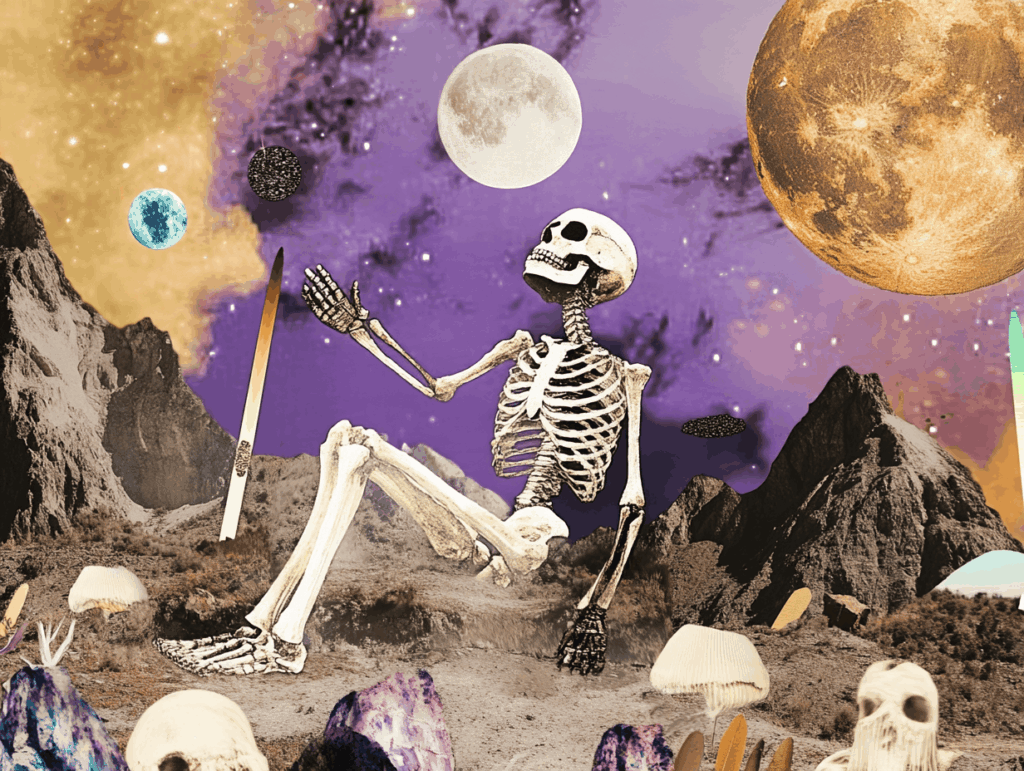
You shuffle the deck, pull a card, and there it is: a skeleton on a horse. Your stomach drops.
“Wait… is someone going to die?”
The Death card looks terrifying, so we assume the worst. But in almost every reading, Death is not predicting literal death.
It’s pointing to an ending, a turning point, or a version of you that’s quietly expired while you’ve been trying to keep life “like it used to be.”
Think of the Death card as a cosmic broom. It doesn’t show up to doom you; it shows up to sweep out what’s stale, heavy, or off-path—especially the things you cling to out of fear or habit. The Death card marks the end of a cycle, not the end of you.
So instead of asking, “Who’s going to die?” try asking:
What is finally ready to be released so something better can grow?
What the Death Card Actually Means
The classic Death keywords—Scorpio, Pluto, transformation, rebirth, endings—give away the plot. This card is about deep change, not disaster.
Scorpio doesn’t do denial. It dives under the surface, drags out what you’d rather ignore, and forces honesty. Pluto, Scorpio’s modern ruler, is the planet of destruction and regeneration. It strips away what’s fake so something real can be built.
Death card is your caterpillar-to-butterfly moment. The old form dissolves so a new one can exist. On paper, the caterpillar “dies.” In reality, it becomes something with wings.
On a mundane level, Death card can feel like finally cleaning out an overstuffed closet. At first it’s chaos—piles everywhere, dust, mild regret. But once you decide what stays and what goes, there’s space again. You can see what you actually want to keep.
The part of you that panics when Death card appears is usually your ego. The ego hates change and clings to familiar patterns, even painful ones. Your soul, though, understands that endings are part of growth. It knows you can’t drag every old story, relationship, and identity into your next chapter and still feel alive.
If you want to go deeper into the imagery, you can always read [Death (XIII)] on its dedicated card page.
The “Surrender Trio”: Where Death Fits in the Journey
Death doesn’t crash into your spread without context. In the Major Arcana, it sits between [The Hanged Man] and [Temperance], forming a kind of “Surrender Trio”—three stages of letting go.
The Hanged Man: the pause.
You know something isn’t working, but you’re not moving yet. Life feels stuck or upside down. The invitation is to see things differently and release the idea that you can control every outcome or timeline.
Death: the release.
This is when the thing you’ve been clinging to actually ends. The breakup happens. The job goes away. The habit cracks. The truth lands. It can feel harsh because it’s final—there’s no going back—but there’s also relief in that honesty.
Temperance: the healing.
After the disruption, Temperance arrives. This is the slow rebuild. You’re not who you were, and you’re not fully formed yet either. Temperance blends old and new, helping you find a more balanced way forward.
You don’t get to skip straight to the calm of Temperance without passing through the cut of Death. The Hanged Man loosens your grip, Death makes the cut, Temperance helps you rebuild. When Death appears, it isn’t punishment—it’s your soul saying, “We’re done here. Let’s move on.”
Examples of “Death” in Real Life
Here’s how the Death card might show up in everyday life—no cloaks, no scythes, just change that was ready to happen.
Career
You’re in a job that quietly drains you. You’ve known for a while it doesn’t fit, but you keep saying it’s “fine.” Death shows up, and soon after, something ends: you resign, you’re laid off, or your role disappears. It’s destabilizing, but it also pushes you to ask what kind of work actually matches who you are now. A follow-up card like Judgement might highlight a deeper wake-up call around your purpose.
Love
A relationship that once felt like home now makes you feel small. You pull the Death card, and not long after, the relationship ends. There’s grief and nostalgia. But with time, you can see the space it opened—for a healthier relationship, or simply for you to remember who you are on your own. Death in love often clears out dynamics that block real intimacy.
Self
Sometimes Death shows up around a pattern you’re finally done with: doom-scrolling, people-pleasing, self-sabotage, always saying yes when you mean no. The “death” here is the old identity. You’re no longer the person who shrugs and says, “That’s just how I am.” You let that version of yourself go so a truer one can take root.
In all of these, the theme isn’t doom. It’s release.
“The Phoenix” Tarot Spread (3 Cards)
When your life feels like smoldering rubble, the Death card can be a map instead of a monster. Try this simple three-card spread, “The Phoenix,” when you’re moving through a big ending or transition.
Card 1: The Ash — What is leaving my life?
This card shows what’s truly finished, even if part of you is still clinging to it. It might be a role, a belief, a coping strategy, or a relationship dynamic. Naming it helps you stop negotiating with what’s already over.
Card 2: The Fire — What is the catalyst for this change?
Here you look at what’s driving the transformation: a conversation you can’t un-hear, a burnout moment, a crisis, a quiet inner knowing. Understanding the “why” makes it easier to work with the process instead of fighting it.
Card 3: The Rising — What new version of me is emerging?
This is your phoenix moment. This card hints at the qualities or opportunities that are becoming available now that the old chapter is closing. It’s less about an exact prediction and more about pointing you toward your next evolution.
You can journal on these cards and revisit the spread over time to see how your own phoenix is rising from the ashes.
Conclusion
The Death card isn’t here to haunt you. It’s here to call time on what’s already over so you can stop dragging its weight into your future.
Don’t fear the reaper; fear staying stuck in a life that doesn’t fit anymore. Death is one of the most liberating cards in the tarot because it promises that this too will pass—the job that crushes you, the relationship that dims you, the storyline that keeps you small.
So the next time Death rides into your reading, pause and ask:
What is being cleared so I can live more honestly?
If you’ve already had a “Death card” moment that turned out to be a blessing in disguise, you’ve already met the real meaning of this card: not ending for the sake of loss, but ending for the sake of who you’re becoming.
