Introduction to the Six of Pentacles Tarot Card
The Six of Pentacles is one of those cards that looks straightforward until you sit with it for five minutes and realize it’s quietly talking about money, power, generosity, shame, gratitude, control, and that weird emotional aftertaste you get when someone “helps” you but you feel like you owe them your firstborn.
It belongs to the suit of Pentacles, which rules the practical, earthly parts of life: work, income, stability, health, home, time, resources, and yes, plain old cash. Pentacles is the suit that asks, “What’s sustainable?” It’s less about lofty intention and more about what actually happens when the bills hit, the deadlines pile up, the groceries need buying, and your body is asking for rest you keep rescheduling.
As the number six in the Pentacles sequence, this card introduces balance. The earlier Pentacles can be very “mine, earned, built, secured.” The Six shifts that energy into circulation. It’s about giving and receiving, and not just in a feel-good, charity-gala way. It’s also about fairness, reciprocity, and what it means to share resources without creating dependency or resentment.
Because giving can be pure. Receiving can be healing. And also, both can get complicated fast.
Sometimes this card comes up when you’re about to be helped, and it’s a genuine gift from life, the kind that makes you exhale. Sometimes it comes up when you’re the one with more to offer, and you’re being nudged to share from a place of integrity. And sometimes, especially when reversed, it’s a blunt reminder that an exchange in your life is out of balance, and you’ve been trying to “positive mindset” your way around the truth.
The Six of Pentacles isn’t dramatic. It’s honest. It asks: Where is the balance in your material world? Who gives? Who receives? Who decides what’s fair? And are you okay with the answers?
Six of Pentacles Tarot Card Keywords
Upright: generosity, charity, balance, support, fairness, reciprocity
Reversed: debt, inequality, selfishness, strings attached, exploitation, imbalance
Six of Pentacles Upright Meaning
Upright, the Six of Pentacles is usually a relief. It’s the moment you realize you’re not alone in a practical way. Not “sending good vibes,” but actual support. The kind you can use.
This card often appears when resources are flowing between people in a way that’s meant to restore balance. You might be receiving help, or you might be in a position to give it. The key, either way, is that the exchange is meant to be clean. Fair. Respectful.
If you’re the giver, the Six of Pentacles upright encourages generosity that doesn’t come with a hidden agenda. It’s not about buying love or collecting loyalty points. It’s about sharing what you have in a way that uplifts someone, not in a way that keeps them small so you can feel big. It’s giving because you can, because you want to, because you remember what it felt like to need.
If you’re the receiver, this card can be a gentle challenge to let support in without spiraling into guilt. For some people, receiving is harder than giving. Giving feels powerful. Receiving can feel vulnerable. You might worry you’re a burden. You might feel embarrassed. You might immediately want to repay, not because you’re ungrateful, but because gratitude can feel too close to dependence.
The Six of Pentacles says: receiving can be part of the cycle, not a moral failure.
In practical readings, this card can point to:
- A gift, grant, raise, bonus, loan, or unexpected financial help
- Someone offering mentorship, guidance, or a connection that opens a door
- A fair outcome in negotiations, contracts, or shared responsibilities
- Support arriving right when you genuinely need it, not just when it’s convenient for someone else
There’s also a lesson here about power dynamics. Even in healthy relationships, giving and receiving can create a subtle imbalance if you’re not mindful. The Six of Pentacles upright asks you to stay aware of intention. Are you giving because it feels good to help, or because you want leverage? Are you receiving because you trust the exchange, or because you feel cornered?
This card doesn’t shame anyone for having more or less. It asks for integrity. It asks for humility. It asks you to remember that “fair” is not always “equal,” but it should still feel respectful.
Upright, the Six of Pentacles is a sign that balance can be restored. Abundance can circulate. Support can be offered and received in a way that leaves everyone with dignity intact.
Six of Pentacles Reversed Meaning
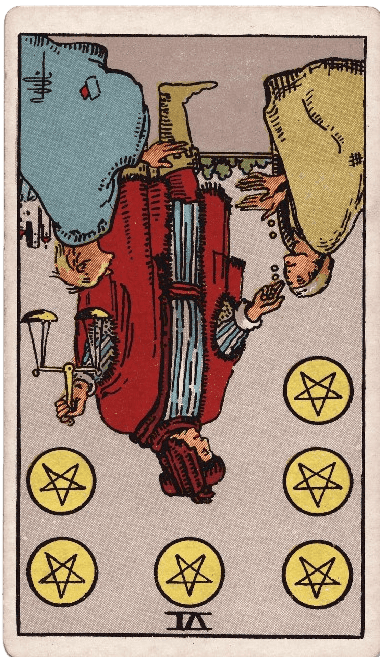
Reversed, the Six of Pentacles is where the sugar coating falls off. It’s the card that says, “Let’s talk about the imbalance you’ve been trying to ignore.”
This reversal often points to unfairness in giving and receiving. One person may be giving far more than they can sustain. Another may be taking more than they realize. Or someone is offering help with strings attached, and you can feel it in your body before you can explain it in words.
A reversed Six of Pentacles can show up as:
- Financial strain, debt, or reliance that feels trapping instead of supportive
- Exploitation, being underpaid, undervalued, or asked to do too much for too little
- “Generosity” that is actually control, guilt, obligation, or manipulation
- A dynamic where you’re always the rescuer, always the responsible one, always the one who figures it out
Sometimes the imbalance is obvious. Sometimes it’s subtle, like a constant emotional expectation that you’ll carry the load. This card can reflect relationships where someone gives gifts but uses them as evidence in every argument. Or a workplace situation where “opportunity” is dangled in front of you while your labor is quietly extracted.
It can also reveal your own patterns. Maybe you overgive because you’re scared of being rejected. Maybe you feel guilty when you say no. Maybe your identity is wrapped up in being the helpful one, the strong one, the one who never needs anything. Reversed, the card asks: what is that costing you?
On the receiving side, this card can indicate accepting support out of desperation, ignoring the long-term consequences, or staying in an unfair arrangement because it feels safer than stepping into uncertainty. It can also highlight shame around needing help, which can lead you to accept less than you deserve, or accept help from the wrong people, just to avoid asking elsewhere.
The reversal is not “never accept help.” It’s “accept help with discernment.”
This is the card that encourages you to renegotiate terms, clarify expectations, set boundaries, and stop participating in exchanges that feel like quiet exploitation. Because generosity should not feel like a leash. And support should not come with humiliation.
Six of Pentacles Symbolism
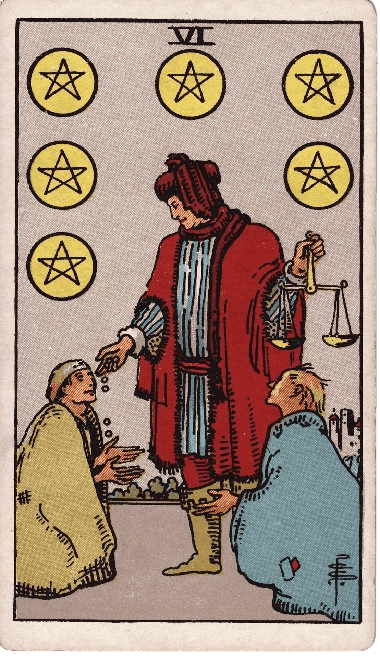
In the Rider-Waite-Smith deck, the Six of Pentacles shows a wealthy figure holding a scale in one hand and giving coins to two beggars with the other. It’s one of the clearest visual metaphors in tarot, and it’s honestly kind of brutal in its honesty.
The scales represent fairness, accountability, ethical distribution. In theory, the presence of the scales suggests justice, that the giver is measuring what’s fair.
But then you notice the posture. The benefactor stands. The receivers kneel.
And suddenly the card isn’t just about charity, it’s about hierarchy.
This picture makes you think about how power changes when one person has more than another. More money, more status, more security, more options, more leverage. Even when someone is generous, the imbalance is still there, and it can affect how the exchange feels.
This card asks: does the giving empower, or does it create dependence? Does it restore dignity, or does it subtly reinforce who’s on top?
The beggars symbolize need, vulnerability, and the openness required to receive. They also symbolize something many people forget: everyone shifts roles at different points in life. You can be the giver in one season and the receiver in the next. The card’s earthy tones and gold pentacles reinforce the Pentacles themes: material resources, stability, responsibility, and the real-world consequences of imbalance.
The symbolism is essentially a mirror. It reflects how you handle having, how you handle not having, and how you handle the emotional complexity of both.
Six of Pentacles in a Love Reading
In love, the Six of Pentacles is all about reciprocity. It’s the relationship audit nobody wants to do, but everyone benefits from.
Upright, it suggests a healthy give-and-take. Care flows both ways. One partner might be supporting the other, emotionally, financially, practically, but it’s not lopsided in a resentful way. It’s loving. It’s “I’ve got you right now, and I trust you’d have me if the roles were reversed.”
This can show up in simple ways: mutual effort, shared planning, emotional availability, fairness around responsibilities. It’s not just romance, it’s partnership. It’s a relationship where kindness is normal, not a special occasion.
For singles, upright can mean meeting someone generous and grounded, or it can be a reminder to approach love with both an open heart and a solid spine. Give affection, yes. Offer effort, yes. But do not audition for love by overgiving.
Reversed, the card points to imbalance. One partner may be doing all the emotional labor. Or one person uses money, gifts, or favors as control. It can be a relationship where gratitude is demanded like rent. It can also signal emotional dependency, where one person feels indebted, and the other feels entitled.
This card reversed asks for honesty about fairness. Not in a petty, scorekeeping way, but in a “can this last without harming someone” way. Love can survive hard seasons. It struggles when imbalance becomes a permanent structure.
Six of Pentacles in a Career Reading
In career readings, the Six of Pentacles often shows up around mentorship, support, compensation, and the distribution of opportunity.
Upright, it can mean you’re receiving help that actually helps: a manager advocates for you, a mentor guides you, you get a raise, you receive resources that make your job more manageable. It can also point to a workplace culture where credit is shared, teamwork is real, and people don’t hoard information like it’s a competitive sport.
If you’re in a position of authority, upright can be a reminder to distribute resources fairly. Pay people appropriately. Give recognition. Share opportunities. Create pathways for others to grow. It’s a card of responsible leadership.
Reversed, the card can highlight exploitation or inequity: being underpaid, undervalued, promised support that never comes, or stuck in workplace politics where “help” comes with conditions. It can also indicate unpaid labor being framed as “experience,” or responsibilities being dumped on you because you’re competent and someone else is not.
This is the card that says: check the terms. Check the fairness. And stop letting guilt replace a proper agreement.
Six of Pentacles in a Financial Reading
Financially, the Six of Pentacles is very literal. It’s about money moving, and whether it moves fairly.
Upright, it can be a positive sign: money coming in through raises, bonuses, gifts, support, investment returns, loans with fair terms, or simply improved financial stability. It can also indicate that you’re in a position to give, donate, tip well, help someone, or share resources without endangering yourself.
It also encourages fair exchange. Charge what you’re worth. Pay what’s fair. Do not undercut yourself out of fear. Do not overextend yourself out of guilt.
Reversed, it warns about imbalance: debt, predatory terms, hidden fees, financial dependency, or accepting help that carries obligations you cannot afford emotionally or practically. It can also point to overspending to prove something, or giving away too much money because boundaries feel uncomfortable.
Reversed, the message is not “be stingy.” It’s “be wise.” Generosity is beautiful, but self-abandonment is not.
Spiritual Meaning of the Six of Pentacles
Spiritually, the Six of Pentacles is the sacred lesson of flow. Giving and receiving are not separate virtues. They’re two halves of the same cycle.
Upright, this card teaches that generosity can be spiritual practice. Helping others with tangible support can be holy. It’s also a reminder that receiving can be spiritual practice too. Accepting help with humility and gratitude is not weakness. It’s participation in community, in reciprocity, in life as a shared experience.
If you’ve been the one always giving, upright can be an invitation to let someone care for you without immediately trying to repay them. Not because you want to owe anyone, but because you are allowed to be held.
Reversed, it can signal blockages in the cycle. Maybe you cannot receive without guilt. Maybe you give too much as a way to feel worthy. Maybe you’re spiritually exhausted from overextending. Or, more seriously, it can point to spiritual manipulation: teachers, communities, or dynamics that use money and power to control people under the mask of guidance.
The lesson is balance. Discernment is spiritual. Boundaries are spiritual. Fairness is spiritual. The Six of Pentacles reminds you that integrity is part of the path, not a side quest.
Cosmic Connections of the Six of Pentacles
Astrology: Often associated with the Moon in Taurus, blending emotional sensitivity with a deep need for stability and security. Taurus wants the basics handled. The Moon wants to feel safe. Together, it’s nurturing through practical care.
If you want context for why Taurus energy is so tied to security and resources, understanding the psychological principles of reciprocity provides a helpful grounding point.
Numerology: 6 represents harmony, responsibility, and balance. It’s the number of maintaining the home, the relationship, the system. It’s the number that asks, “Is this sustainable for everyone involved?”
Element: Earth, the element of stability, resources, embodiment, and practical reality.
These correspondences underline the card’s core theme: generosity works best when it’s grounded, fair, and free of manipulation.
Questions to Ask When the Six of Pentacles Appears
- Where in my life am I being asked to give, and where am I being asked to receive?
- Am I approaching generosity with genuine compassion, or with expectations?
- What power dynamics are influencing my relationships or financial situations?
- How can I create more balance in my giving and receiving of time, money, or energy?
The Six of Pentacles in a Yes No Reading
In a Yes No reading, the Six of Pentacles usually points to Yes, with one big condition: the exchange needs to be fair.
Upright: Yes.
Yes, support is available. Yes, the situation can work out. Yes, resources can flow in a way that helps you. This is a good sign for accepting offers, entering partnerships, negotiating compensation, or asking for help, especially if terms are clear and respectful.
Reversed: Maybe, leaning no.
Reversed means that there are strings attached, an imbalance, or conditions that could cost you more than you think. It’s not always a hard no, but it’s a strong warning to pause, ask questions, renegotiate, or walk away if the deal makes you feel uneasy.
A quick gut check: if the help feels heavy, it’s worth investigating why.
The Bottom Line
The Six of Pentacles is a card that shows how to be generous and keep things in balance in the real world, where money and help are never just ideas. When it is upright, it is a reassuring sign that help can come, fairness can be restored, and people can give and receive with dignity. It reminds you that support is a part of life, and that you can be both the giver and the receiver at different times.
Reversed, it is a clear sign to check the imbalance.It tells you to be honest about who is in charge, what the rules are that aren’t written down, and whether a deal is taking away your freedom, peace, or self-respect without you knowing it. It encourages limits, judgment, and a return to fairness, not just in theory but also in how we spend our time, money, energy, and care every day.
At its heart, the Six of Pentacles teaches that fairness is a form of love. And that the healthiest kind of generosity is the kind that doesn’t require anyone to kneel.