

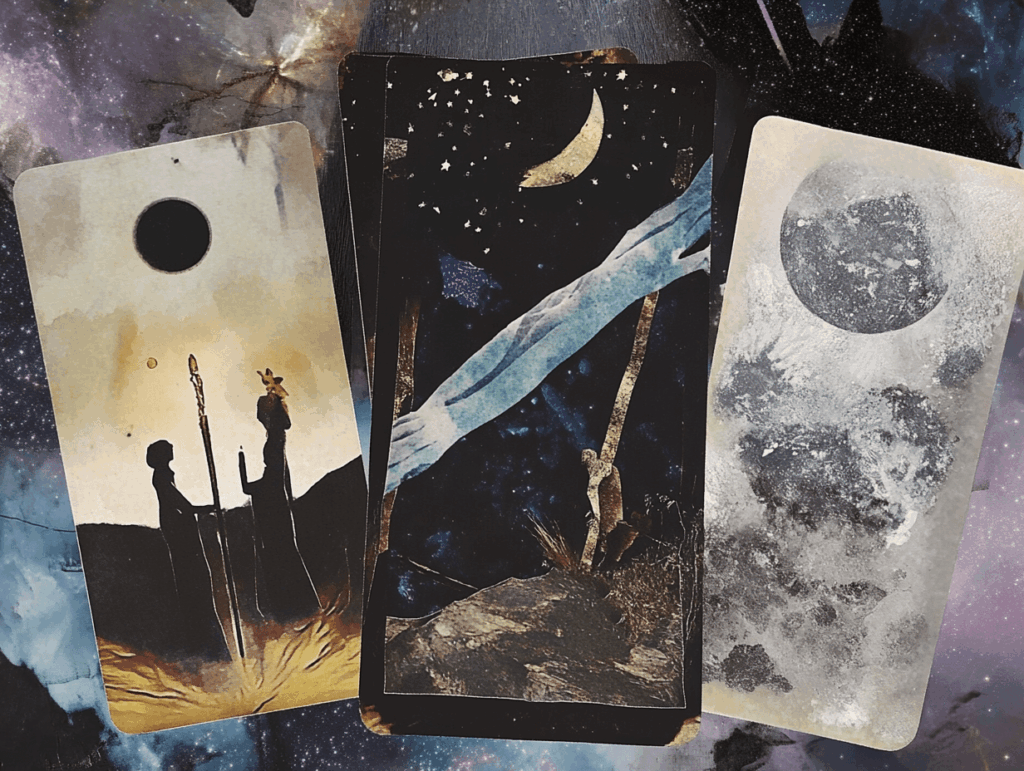
Learning tarot can feel a little like someone dumping 78 tiny paintings in your lap and saying, “Great, memorize all of these and also, by the way, use them to predict the future.” A lot of us do the same thing: we buy a beautiful deck, flip through the cards, maybe try one giant Celtic Cross… and then quietly put everything back in the box when it starts to feel like homework.
Tarot doesn’t have to be a whole production, though. You don’t need incense, robes, and a ten-card spread to get something real out of it. The gentlest entry point is the Daily Draw: five minutes, three cards, one honest question. That’s it. No drama required (unless you’re in the mood).
The Daily Draw is a powerful way to connect with your intuition.
When you keep showing up for this tiny ritual, the Daily Draw serves as a bridge between your inner world and the messages of the tarot. You stop treating tarot like a test you’re going to fail and start treating it like a conversation—with your deck, sure, but also with yourself.
Why Pull Cards Every Day?
Utilizing the Daily Draw allows for a quick check-in with your emotions and thoughts.
Daily pulls are basically little voice notes to your future self—quick, imperfect, and unexpectedly revealing.
With each Daily Draw, you’ll develop a deeper understanding of your personal symbols.
The Daily Draw can help clarify your intentions and lead your day.
As you engage in a Daily Draw, consider how each card reflects your life.
Reading tarot is a skill, not some mysterious family heirloom passed down by one witchy aunt. Like playing the guitar, lifting weights, or parallel parking on a busy street, you get better by doing it badly a bunch of times first. The more often you shuffle, pull, and actually sit with your cards, the more your intuition starts showing up before your brain can reach for the guidebook.
Embracing the Daily Draw can transform your tarot practice.
Over time, you’ll catch yourself thinking things like, “Wow, every time the Two of Pentacles shows up, my schedule is chaos,” or “Okay, the Nine of Swords is back, which usually means I’m spiraling at 2 a.m. about nothing and everything.” The meanings stop being abstract and start feeling lived-in.
It’s also incredibly grounding. You’re not always asking, “What’s going to happen to me?” (which is a stressful way to start a Tuesday). A better question for a daily draw is often, “How am I showing up today?” or “What do I need to be aware of?” A 3-card spread can name your mood, your fears, your hope, and that quiet ache you’ve been trying not to look at. Even if the future stays blurry, you walk away knowing yourself more clearly.
And then there are the stalker cards—the ones that just… won’t… leave. You only catch them when you read consistently. Maybe The Devil keeps inserting itself whenever you tell people your “casual” situationship is totally fine. Maybe The Hermit shows up week after week while you insist you’re “too busy” to rest. Once you notice the same card following you around, it gets a lot harder to pretend you don’t know what needs to change.
The 3 Best 3-Card Spreads for Beginners
Think of these as three different lenses you can snap over the same day. You don’t need fifty spreads; you need a few solid ones you can actually remember when your brain is tired.
1. The Classic Timekeeper (Past / Present / Future)
Use this when you want a simple storyline.
- Past: What led you here.
This card shows the backstory—the choices, habits, or old energy that created the situation you’re in now. - Present: The energy right now.
What’s actually happening in this moment: your emotional state, the vibe around you, the “weather report” for today. - Future: Where things are headed if nothing really changes.
It’s not a fixed fate, but a likely trajectory. If you don’t love what you see, that’s information—and an invitation to do something differently.
2. The Wellness Check (Mind / Body / Spirit)
Use this when you feel “off” but can’t quite name why.
- Mind: What you’re obsessing over or avoiding.
This card points at your mental loop. Are you ruminating about a text, catastrophizing worst-case scenarios, or mentally checking out completely? - Body: What your physical self is asking for.
More sleep? Food that isn’t a handful of crackers? Stretching? A walk? Maybe even an actual doctor’s appointment you’ve been ignoring. This card is your somatic nudge. - Spirit: The bigger lesson underneath it all.
Here’s the zoom-out: what is your soul trying to learn right now? Where are you being pushed to grow, soften, or finally let go?
This spread is perfect for days when “Will I get the job?” isn’t the real question—“How am I actually doing?” is.
3. The Problem Solver (Situation / Obstacle / Advice)
Use this when you’re stuck on something specific: work drama, money decisions, creative blocks, relationship confusion—anything that has you in a loop.
- Situation: What’s actually going on.
This card cuts through the noise and names the real issue, not just the loudest symptom. - Obstacle: What’s in the way (inner or outer).
The block might be external—timing, other people, logistics—or internal: fear, avoidance, perfectionism, people-pleasing. The card here shines a light on what’s really blocking movement. - Advice: What to do next.
This is your next step, not your whole five-year plan. It might point to a boundary, a conversation, a mindset shift, or one concrete action you can take.
Rotate these spreads and you’ll rarely find yourself staring at your cards thinking, “Okay… now what?” You’ll have a framework ready to go.
Example Reading: “The New Project”
Let’s put this in context.
Say you’re thinking about starting something new—a business, a creative hobby you might someday monetize, a tarot account, a shop, a podcast. You shuffle your deck and ask:
“What do I need to know about starting this new project?”
Your Daily Draw can lead to unexpected insights.
Let’s say you pull cards during your Daily Draw to seek guidance about work.
This is a great time to incorporate your Daily Draw into your routine.
You choose the Problem Solver spread.
Situation – The Fool
The Fool here is all about fresh-start energy. You’re standing at the edge of something that feels equal parts terrifying and thrilling. You might be thinking, “I have no idea what I’m doing, but I can’t shake this idea.” The Fool says this isn’t a random whim—it’s a real beginning trying to get your attention.
→ Read more about the innocent potential of The Fool.
Obstacle – The Magician
Seeing The Magician as the obstacle can throw you for a second. Isn’t this supposed to be a good card? It is—but in this position, it’s pointing to self-doubt. You do have the skills, resources, and ideas. You’re just not believing they’re enough yet. The problem isn’t that you’re missing something; it’s that you’ve decided what you already have doesn’t “count.”
The message? Stop waiting to feel perfectly prepared. Your toolkit is already on the table.
→ Discover how to manifest with The Magician.
Advice – The High Priestess
The High Priestess as advice tells you to move forward, but in a way that feels quietly true, not performative. You don’t need a whole brand launch and a five-year roadmap. You need to listen to your gut and take the next small, aligned step: start the draft, tell one trusted friend, soft-launch the offer.
She also suggests that this path will reveal things over time—hidden desires, patterns, or truths about what you actually want from your work or creativity. You won’t have all the answers at the beginning, but they’ll meet you as you go.
→ Learn to access your intuition with The High Priestess.
Taken together, the spread is saying:
- You’re at the start of an authentic new chapter (The Fool).
- You already have what you need, but you’re underestimating yourself (The Magician).
- The way forward is to trust your inner voice more than external approval or rigid logic (The High Priestess).
That’s what a simple 3-card reading can do: take you from “Should I even do this?” to “I’m nervous, but I’m ready—and I know my first step.”
In your Daily Draw, it’s essential to reflect on the messages each card provides.
How to Keep a Tarot Journal
The Daily Draw helps you track patterns over time.
Your tarot journal doesn’t need to be beautiful or profound. It just needs to exist and be something you’ll actually use.
For each daily draw, jot down:
- The date
- Your question
- The three cards you pulled
- One or two lines about what you think they’re saying
That’s enough. Over time, you’ll flip back and see the repeating themes, the stalker cards, and the way your interpretations of certain cards evolve as you do. If you ever feel like making it fancier—a full journaling ritual, spreads for reflection, monthly recaps—you can build from this foundation.
For each Daily Draw, take a moment to reflect on your intentions.
Conclusion
You don’t have to be a tarot expert to get real value from your deck. You just have to show up—consistently, imperfectly, a few minutes at a time.
A simple 3-card spread every morning will teach you more about your patterns, your fears, your desires, and your magic than one giant, dramatic reading you do once a month and then avoid. Try the Situation/Obstacle/Advice spread tomorrow. Ask about whatever’s tugging at your brain.
See what comes up. And then, write it down.
Make sure to note your Daily Draw insights in your journal.
Consider what you’re learning from your Daily Draw readings.
Ultimately, the Daily Draw is a tool for empowerment.
This approach to your Daily Draw is all about self-discovery.
