Introduction to the Seven of Swords Tarot Card
The Seven of Swords is one of those tarot cards that can make a reading feel suddenly… quiet. Not peaceful-quiet. More like the kind of quiet you get when you realize you left your phone face-up on the table and a message just popped up. It’s a card that brings in secrecy, strategy, and yes, sometimes deception. But it’s also one of the most human cards in the deck, because it asks a question we all wrestle with at some point: What am I doing, and why am I doing it like this?
People tend to treat the Seven of Swords like a red-flag siren, and sometimes it is. Sometimes it’s a warning about dishonesty, manipulation, or someone sliding around the truth like it’s a puddle they don’t want to step in. But other times, it’s less “someone is lying” and more “someone is trying to survive.” It can show up when you’re choosing discretion over drama, strategy over confrontation, privacy over oversharing. It’s complicated. That’s kind of the point.
In readings, the Seven of Swords invites you to look beneath the surface, not just at what someone is doing, but at the motive underneath it. It asks you to check your own integrity, your own fear, your own avoidance. And if that sounds heavy, it can be. But it can also be clarifying in a way that feels like exhaling. Because once you name what’s happening, you can stop guessing.
Seven of Swords Keywords
- Upright: Deception, strategy, cunning, independence, careful planning, resourcefulness
- Reversed: Exposure, self-deceit, consequences, coming clean, guilt, making amends
Seven of Swords Upright Meaning
When the Seven of Swords appears upright, it usually points to strategy, stealth, or a situation where someone is not being fully direct. Sometimes that’s shady. Sometimes it’s smart. Sometimes it’s both, and that’s when the card gets interesting.
On a practical level, this card can show up when you’re avoiding confrontation. Maybe you’re dealing with a workplace situation where saying exactly what you think would create fallout you cannot afford right now. Maybe you’re navigating family dynamics where honesty needs to be delivered with timing and tact, not as a grenade. The Seven of Swords can represent that behind-the-scenes approach, the “let me handle this quietly” energy.
At its best, upright Seven of Swords can be the card of resourcefulness. The person who solves a problem creatively. The person who thinks three moves ahead. The person who refuses to be boxed in by how things are “supposed” to be done. It can also be independence, the kind that doesn’t ask permission. Sometimes this card appears when you’re forging your own path, even if you haven’t announced it yet. It’s a private decision taking shape.
But we also have to talk about the other side, because it’s real. Upright Seven of Swords can be a warning about deception, manipulation, or cutting corners. This might be someone lying to you, or it might be you lying to yourself. It might be a situation where the truth is being edited, omitted, softened, strategically withheld. And sometimes that’s a survival tactic. Other times it’s a choice that will cost more than it saves.
This card asks you to consider long-term consequences. Not in a moralistic way, like a scolding parent. More like: What happens when this comes out? What happens if you keep doing it like this? Because secrets have a way of getting heavier over time. Lies require maintenance. Half-truths demand more half-truths to protect them.
If the Seven of Swords shows up upright, it’s worth asking:
- Am I being strategic because it’s wise, or because I’m scared?
- Am I protecting something, or am I avoiding accountability?
- Is this discretion, or is this dishonesty?
The difference usually lives in intention, and in impact. If your strategy harms others, exploits trust, or erodes your own self-respect, the card is waving a little flag. If your strategy is about boundaries, privacy, and navigating complexity with care, the card can be supportive. Same behavior, different motive. Tarot loves that kind of nuance.
Seven of Swords Reversed Meaning
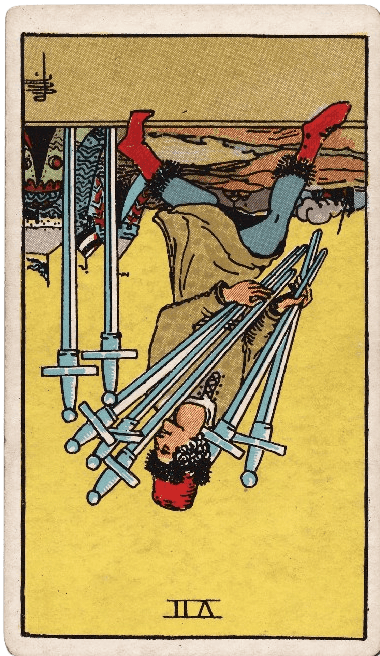
Reversed, the Seven of Swords tends to bring things into the light. It’s the moment the secret starts to crack. The moment the story stops holding. The moment someone realizes they can’t keep pretending everything is fine because it’s not.
In many readings, the reversed Seven of Swords suggests exposure. Hidden motives, lies, or behind-the-scenes actions may be revealed, sometimes dramatically, sometimes quietly, sometimes in a way that makes you think, “Oh, so that’s what that was.” If you’ve been sensing something was off, this reversal often confirms it. It can feel validating, and it can also feel heartbreaking. Both can be true.
This card can also show guilt and regret. Maybe you did something you’re not proud of. Maybe you convinced yourself it was harmless, or necessary, or temporary. Now you’re seeing the ripple effects. Reversed Seven of Swords is an invitation to take responsibility, not as punishment, but as a path back to integrity. It asks: how can you make amends? How can you repair trust? How can you tell the truth, even if it’s uncomfortable?
And sometimes the “truth” is internal. The reversed Seven of Swords can be about self-deception. The ways we talk ourselves into a false narrative because it’s easier than facing what we really want, or what we really know. It’s the story you keep repeating because it keeps you safe. It’s the excuse you cling to because the alternative requires change.
There’s also a surprisingly tender interpretation here: liberation from secrecy. This reversal can appear when you’ve been hiding part of yourself, your needs, your plans, your feelings, because you feared judgment or rejection. The card can signal that coming clean will bring relief. Not always instant relief, but the kind that comes from not carrying a private burden anymore.
Reversed Seven of Swords isn’t always comfortable. But it’s honest. And honesty is often the first step toward peace.
Seven of Swords Symbolism
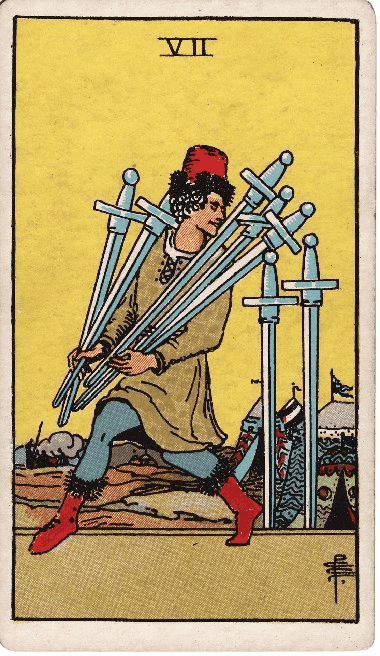
The imagery of the Seven of Swords, especially in the Rider-Waite-Smith deck, is practically a short story.
A figure sneaks away carrying five swords, while two remain behind. The person glances back over their shoulder, as if checking whether they’ve been seen. In the distance, there’s a camp. Community. Structure. A group setting. And here’s this person operating outside it.
That visual alone holds a lot:
- The act of sneaking away suggests secrecy, independence, and a choice to act alone rather than in the open.
- The five swords taken can stand for what someone thinks they can get away with or what they have chosen to say.
- The two swords left behind can hint at unfinished business, incomplete planning, or the fact that you cannot take everything with you, no matter how clever you are.
- The backward glance is my favorite detail, because it contains tension. There’s awareness. Anxiety. Suspicion. Maybe even a flicker of shame. It implies, “I know this might catch up with me.”
Then there’s the number seven, which often carries themes of analysis, introspection, and spiritual lessons. Sevens tend to ask “why” questions. They pull you into the deeper motive under the surface action. In this card, the “why” is everything. Are you stealing? Escaping? Protecting yourself? Outsmarting someone? Crossing a line? Trying to survive? The symbol doesn’t answer for you. It prompts you.
Even the atmosphere matters. The yellow sky suggests intellect, the mind at work, mental calculations. The muted tones of the camp reinforce the feeling of secrecy and separation. It’s a card that lives in the gray area, the in-between space where intention and ethics collide.
Seven of Swords in a Love Reading
In love readings, the Seven of Swords can be unsettling because it touches on trust. And trust is not a small thing. It’s the foundation you don’t notice until it starts to crack.
Upright, this card can suggest secrecy in a relationship. That could mean someone withholding feelings, avoiding commitment, or keeping information back. It could also point to emotional distance, the kind where a person stays technically present but never fully lets you in. Sometimes it’s outright dishonesty, but sometimes it’s fear disguised as privacy.
It can also show up when someone is dodging a conversation they know they need to have. The Seven of Swords doesn’t always mean cheating, despite the internet’s obsession with that interpretation. Sometimes it means someone is not being straightforward, period. And the question becomes: why?
On the more constructive side, upright Seven of Swords can reflect the need for boundaries. There are times in love when discretion is healthy: protecting your relationship from outside interference, keeping something private until it’s stable, choosing not to share everything with people who don’t wish you well. Not everyone deserves full access to your heart story.
Reversed, the Seven of Swords often points to truth coming out. Confessions. Real conversations. A situation where what’s been hidden is finally named. This can be painful, but it can also be freeing. Sometimes you cannot repair something until you stop pretending nothing happened.
For singles, reversed Seven of Swords can be about dropping self-deception. Like finally admitting you want a real relationship, not a situationship that keeps you in limbo. Or admitting that you keep chasing unavailable people because it feels safer than being truly seen. The reversal can be a gentle wake-up call: you deserve honesty, starting with your own.
Seven of Swords in a Career Reading
Career readings love the Seven of Swords because workplaces are basically ecosystems of strategy. Sometimes that strategy is healthy. Sometimes it’s petty. Sometimes it’s straight-up exhausting.
Upright, this card can signal office politics, backroom deals, people operating with hidden agendas, or situations where you need to tread carefully. It might mean someone is not being transparent about expectations. It might mean you need to read the fine print, keep receipts, and trust your observations. It can also represent independent work, entrepreneurship, or unconventional approaches that require discretion.
If you’re building something new, upright Seven of Swords can be the energy of working quietly until you’re ready to launch. Not everyone needs to know your plan while it’s still fragile. In that context, the card can feel protective: keep your strategy close, move smart, don’t announce everything too early.
But if the card feels tense in a career reading, consider whether someone is cutting ethical corners. Are you being asked to do something that doesn’t sit right? Are you tempted to shortcut the process? This is where the Seven of Swords becomes a values check. It asks: is the win worth the cost?
Reversed, the career message often involves exposure. A secret at work comes out. A dishonest colleague gets caught. A situation that’s been quietly unfair becomes visible. Or, on a personal level, you realize that pretending and performing is draining you, and you’re ready to be more direct.
For career changers, reversed Seven of Swords can be a call to honesty about what you actually want. Not what looks good. Not what feels safe. What you want. That can be a scary truth to face, but it’s also the kind that changes your life.
Seven of Swords in a Financial Reading
When money is involved, the Seven of Swords tends to carry a very clear message: be alert.
Upright, this card can signal hidden costs, fine print, sneaky terms, or someone trying to take advantage. It’s not a paranoia card, but it is a “double-check the details” card. It can also reflect clever financial planning, especially if you’re working with limited resources. Budgeting, strategizing, finding creative ways to stretch what you have, that’s the healthy side of Seven of Swords energy.
But if something feels too good to be true, upright Seven of Swords says: it probably is. Read the contract. Ask the question you’re afraid will make you seem “difficult.” Protect yourself.
Reversed, financial truths come into focus. You might uncover a scam, catch an error, or finally look at your bank account without flinching. Sometimes it’s not about someone else deceiving you, it’s about you avoiding reality because it’s stressful. The reversal encourages honesty in budgeting, investing, and long-term planning. You cannot build stability on denial.
It can also suggest making amends with money. Paying something back. Cleaning up a mess. Facing the consequences of a past choice. Not as shame, but as closure. As taking your power back.
Spiritual Meaning of the Seven of Swords
Spiritually, the Seven of Swords is about integrity. Not performative integrity, not “I post about healing on Instagram” integrity. Real integrity. The kind that shows up in how you treat people when nobody is watching, and how honest you are with yourself when you’re alone.
Upright, this card asks whether you’re walking your path authentically or hiding behind masks. It can also be a caution about spiritual illusion: teachers who are not what they seem, communities that look enlightened but behave poorly, practices that become a way to avoid real emotional work.
It can also show up when you’re keeping your spirituality private, which is not always a problem. Sometimes privacy is protection. Sometimes you are still forming your beliefs and you don’t want them debated in a group chat. That’s valid.
But if the card feels like a warning, it may be highlighting self-deception. The ways we rationalize. The ways we bypass. The ways we use cleverness to avoid vulnerability.
Reversed, the Seven of Swords often points to shadow work. Facing what you’ve been avoiding. Naming the truth you keep circling. It’s an invitation to stop lying to yourself about what hurts, what you need, what you’re afraid to admit. The reward is growth that’s grounded. Not airy. Not performative. Real.
At its core, this card reminds you that spiritual evolution is built on honesty. With others, yes. But especially with yourself.
The Seven of Swords in a Yes No Reading
The Seven of Swords is rarely a simple “yes, queen” card. In yes-no readings, it tends to behave like a spotlight aimed at motives.
Upright: Often No, or at least “not safely.” Upright Seven of Swords suggests hidden information, mixed motives, or a situation where someone is not being fully honest. If you’re asking, “Can I trust this?” the answer is usually: proceed with caution. Ask more questions. Verify. Protect yourself.
That said, if the question is about strategy, like “Should I keep my plans private for now?” or “Should I handle this discreetly?” upright Seven of Swords can lean Yes, especially if privacy is the wise move. The key is intention. Are you being discreet to protect something, or secretive to avoid responsibility?
Reversed: Often Yes, but with accountability. Reversed Seven of Swords can indicate coming clean, clearing the air, and moving forward with honesty. If you’re asking whether truth will come out, the card often says yes. If you’re asking whether you should tell the truth, it strongly leans yes, because the relief on the other side is real.
If you want a good clarifying question when this card shows up in yes-no readings, try: What’s being hidden here, and who benefits from it staying hidden? That one gets to the heart of the Seven of Swords fast.
Cosmic Connections of the Seven of Swords
The Seven of Swords is often associated with the Moon in Aquarius, which makes sense in a way that feels almost too accurate. The Moon rules emotions, instincts, and the private inner world. Aquarius is cerebral, unconventional, detached when it needs to be, and sometimes committed to an idea more than a feeling.
Put them together and you get emotional strategy. The mind trying to solve what the heart doesn’t want to feel. The impulse to keep distance, to be clever, to stay one step ahead. Moon in Aquarius can be brilliant, but it can also be avoidant. It can rationalize anything if it’s scared enough.
Numerologically, the number seven is introspection, analysis, and the pursuit of truth. It’s the seeker number, the detective number. In the suit of Swords, that truth-seeking turns mental. It can be insight, discernment, and sharp thinking. It can also become overthinking, paranoia, and justification.
Elementally, Swords are Air, linked to intellect, communication, and mental processes. This is why the Seven of Swords is such a “mind” card. It’s about narratives, stories, strategies, and what people choose to say or not say. It reminds you that words matter, and so does silence.
If you want a useful psychological lens for this card’s inner conflict, reading about cognitive dissonance can be illuminating, especially the way people justify choices that don’t align with their values.
Questions to Ask When the Seven of Swords Appears
- Am I being fully honest with myself and others in this situation?
- What truths might be hidden, or conveniently ignored, right now?
- Where am I relying on strategy instead of authenticity, and is it actually working?
- How can I protect myself without losing my integrity?
- What would change if I faced this directly, calmly, and clearly?
The Bottom Line
The Seven of Swords is the card of strategy, secrecy, and the uncomfortable truth that humans are complicated. Upright, it can represent clever planning, independence, and navigating situations with tact. It can also be a warning about dishonesty, manipulation, and the kind of shortcut that eventually becomes a trap.
Reversed, the card tends to bring truth into the open. Secrets crack. Stories unravel. Guilt surfaces. And with that comes an invitation: tell the truth, take responsibility, make amends, choose integrity even if it costs you comfort in the short term.
In love, it asks you to look at trust and transparency. In career, it asks you to navigate politics without losing yourself. In finances, it asks you to watch the fine print and face reality. Spiritually, it asks for honesty that’s not performative, but foundational.
The Seven of Swords is not here to shame you. It’s here to sober you up. To sharpen your discernment. To remind you that cleverness can be a tool, but integrity is what gives you peace.