
Have you ever noticed how all the Fives in Tarot kind of suck, and all the Tens feel like some sort of finale—whether it’s happily-ever-after or “we’ve hit rock bottom”? It’s not just a pattern your brain made up. It’s not random at all.
The deck is wired that way. On purpose.
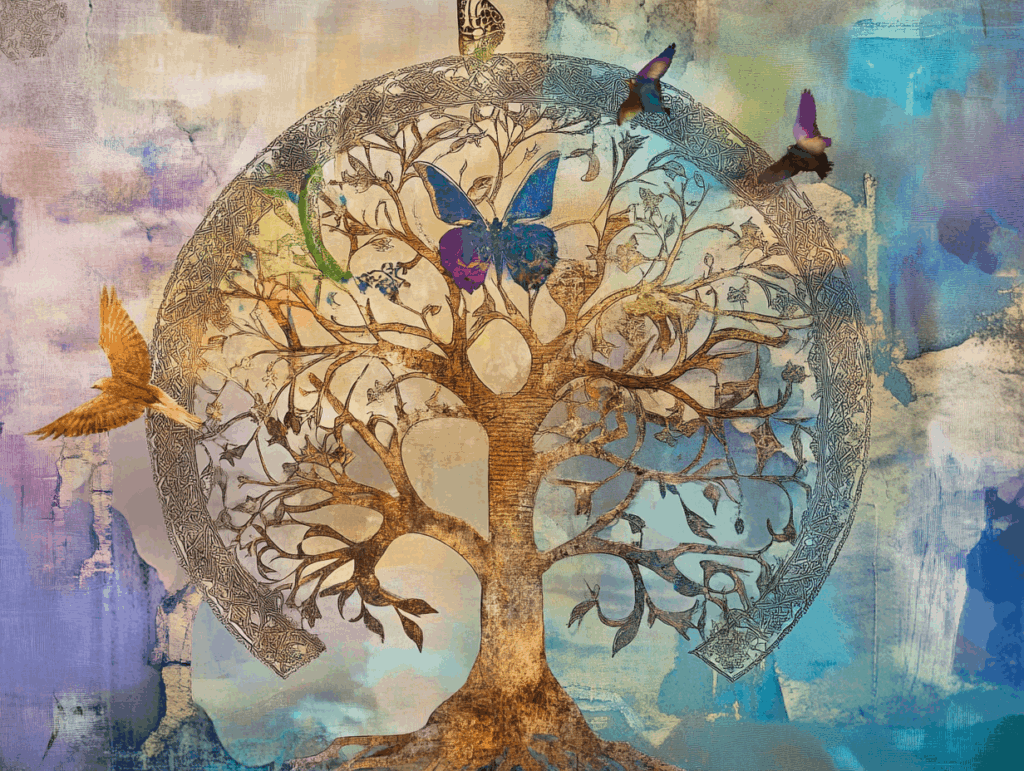
Underneath the cards is this huge, nerdy, mystical framework called the Kabbalistic Tree of Life—Etz Chayim in the Kabbalistic tradition. Think of it as the blueprint for how energy moves from “pure divine idea” into “ugh, why did my boss send that email.” Tarot is basically the illustrated version of that map.
Once you see how the numbers 1–10 in the Minor Arcana line up with the 10 Sephiroth (spheres) on the Tree of Life, the cards stop feeling like a pile of keywords you’re supposed to memorize. The meanings start to make sense in your bones.
What is the Kabbalistic Tree of Life?
Okay, very quick crash course.
The Tree of Life is a mystical diagram used in Kabbalah: ten spheres of energy (called Sephiroth) connected by 22 paths. It shows how infinite, formless, divine energy at the top—Kether, “The Crown”—filters down, step by step, until it becomes Malkuth, the physical world we live in.
You can imagine it like light passing through layers of stained glass. At the top, it’s pure white light. By the time it reaches the bottom, it’s specific: a job, a relationship, a body, a bank account, an apartment with a leaky sink.
Kabbalah also speaks of Four Worlds—layers of reality that mirror how energy condenses:
- Atziluth – the world of Spirit (Fire)
- Briah – the world of Creation (Water)
- Yetzirah – the world of Formation (Air)
- Assiah – the world of Action and Matter (Earth)
Now look at the Tarot: Wands, Cups, Swords, Pentacles.
Each suit lines up with one of those elements and worlds. The same Tree of Life “flows” through each suit, but it feels different depending on whether it’s showing up as fire, water, air, or earth.
If you want to nerd out more about that elemental layer, take a detour and read about the Four Elements of Tarot and then come back. It’ll make everything I’m about to say feel even more satisfying.
The 10 Sephiroth & The Minor Arcana
Here’s the fun part: each number in the Minor Arcana—from Ace (1) to Ten (10)—corresponds to one of the Sephiroth on the Tree of Life. That’s why “all the Fives” feel similar even though they’re different suits. They’re all plugged into the same sphere on the Tree.
Let’s go number by number.
1. Kether (The Crown) → The Aces
Vibe: Pure potential. The spark before anything actually happens.
Kether is the “idea before the idea.” Nothing is formed yet. Nothing’s been chosen. It’s just raw possibility.
That’s why the Aces feel like doors opening rather than events playing out. Ace of Wands? Creative spark. Ace of Cups? Emotional or spiritual opening. Ace of Swords? A new insight or truth. Ace of Pentacles? A chance at real-world stability.
They’re opportunities, not outcomes. Kether is “this could be everything,” but it’s up to you to do something with it.
2. Chokmah (Wisdom) → The Twos
Vibe: Movement, force, “let’s go.”
Chokmah is the first push forward. It’s often called the “Father” principle—raw, active energy.
So in Tarot, the Twos are where the Ace’s abstract potential starts to move: decisions, duality, tension between options, or two forces meeting. Two of Wands: planning or plotting the next move. Two of Cups: connection. Two of Swords: stalemate, but still a choice waiting.
Chokmah is the energy that refuses to stay theoretical.
3. Binah (Understanding) → The Threes
Vibe: Form, structure, “the Mother.”
Binah takes raw energy and gives it a container. It’s the womb, the plan, the shape.
That’s why Threes feel like creation. The Three of Pentacles is literally about building something. The Three of Cups is emotional support and celebration. The Three of Wands is expansion after planning.
Binah is where ideas stop being just ideas and begin to become something you can point to.
4. Chesed (Mercy) → The Fours
Vibe: Stability, kindness, expansion through order.
Chesed is benevolent structure. It’s the “we’ve built a base, now we can relax a little” energy.
In Tarot, Fours feel like a plateau. Four of Wands is happiness and homecoming. Four of Cups is emotional stagnation—“meh” energy. Four of Swords is rest and recovery. Four of Pentacles is hanging on tightly to what you have.
You can feel Chesed in that sense of: I’m safe for a minute—but if I never move again, I might calcify here.
5. Gevurah (Severity) → The Fives
Vibe: Conflict, discipline, “this isn’t working—break it.”
Gevurah is the force that challenges. It cuts, confronts, and tests. Not because the universe hates you, but because stagnation isn’t the point of incarnation.
This is why all the Fives are rough.
Five of Wands: conflict and competition.
Five of Cups: grief, regret.
Five of Swords: hollow victory, cruelty, ego wars.
Five of Pentacles: scarcity, feeling shut out.
Gevurah is what happens when the stable structure of the Four gets shaken to see if it can actually hold. It’s uncomfortable, but it’s the pressure that reveals what’s real.
6. Tiphareth (Beauty) → The Sixes
Vibe: Harmony, heart, the Sun in the middle of the Tree.
Tiphareth is the center point—where everything lines up just enough for clarity to break through.
That’s why Sixes feel like the “after” scene. After the chaos of the Fives, they bring healing and balance. Six of Wands: recognition and victory. Six of Cups: tenderness, memory, sweetness. Six of Swords: transition from stormy to calmer waters. Six of Pentacles: give-and-take, generosity.
Tiphareth is beauty born from surviving the mess.
7. Netzach (Victory) → The Sevens
Vibe: Desire, emotion, instinct, nature at full volume.
Netzach is wild, Venusian, and a little dramatic. It’s the realm of feelings, instincts, and cravings.
So the Sevens can be… a lot. The Seven of Cups is overwhelmed with choices and fantasies. The Seven of Wands is defending your ground. The Seven of Swords is strategy, sometimes deception. The Seven of Pentacles is “I planted this—now what?” impatience.
Netzach is messy, but it’s also where passion lives.
8. Hod (Splendor) → The Eights
Vibe: Mind, language, systems, structure.
Hod comes in after Netzach’s emotional chaos and tries to organize it. It’s Mercury—analysis, logic, communication.
That’s why Eights often feel mental or systematic. Eight of Swords: trapped in your own thoughts. Eight of Wands: messages flying, movement, momentum. Eight of Pentacles: skill-building through repetition. Eight of Cups: emotional reorganization—walking away when something no longer fits.
Hod is where we think about what we feel and build patterns around it—for better or worse.
9. Yesod (Foundation) → The Nines
Vibe: Dreams, the subconscious, the moonlit hallway before the door.
Yesod is the “staging area” before reality. It’s where all the energies of the Tree pool together, right before they hit the physical world.
So the Nines feel intense and saturated. Nine of Cups: wish fulfillment—and sometimes overindulgence. Nine of Swords: anxiety, nightmares, overthinking. Nine of Wands: resilience, almost at the end but exhausted. Nine of Pentacles: self-sufficiency, enjoying what you’ve built.
Yesod is the last inhale before Malkuth, where everything becomes real.
10. Malkuth (Kingdom) → The Tens
Vibe: Reality. The world. The end of the line.
Malkuth is where energy arrives and solidifies. It’s your actual life: body, rent, relationships, the physical and material story.
That’s why Tens feel like endpoints. Ten of Pentacles: long-term wealth and legacy. Ten of Cups: emotional fulfillment and family. Ten of Wands: burnout and burden. Ten of Swords: rock bottom, yes—but also the moment before the sun rises again.
Whatever started as an Ace has now fully played out. Malkuth is where the story lands.
Why This Matters for Your Readings
Here’s the part that makes your brain sigh with relief: once you understand this structure, you don’t have to memorize 40 separate meanings.
You just ask:
- What Sephira is this number?
- What element/suit is this energy flowing through?
For example:
You pull the Five of Swords and your mind goes blank.
You remember: 5 = Gevurah (Severity, conflict, pressure) and Swords = Air (mind, communication, beliefs).
So even without a little white book, you can guess: this card is about mental conflict, harsh communication, or a painful win that costs too much.
Same formula works with anything:
- Seven of Cups: Netzach (emotion, desire) + Cups (Water/feelings) = emotional overwhelm, fantasy, illusions.
- Four of Pentacles: Chesed (stability) + Pentacles (Earth/money/body) = clinging to security, stable but maybe stuck.
It becomes less “Tarot is mysterious and random” and more “Tarot is a symbolic language with actual grammar.” Once you learn the grammar, you can improvise.
Conclusion
Tarot isn’t just fortune telling. It’s a map of how the soul descends into matter—from pure intention at Kether to full-on lived reality at Malkuth. Every numbered card in the Minor Arcana is a snapshot of that journey, one step along the Tree of Life.
The next time you lay out a spread, don’t just squint at the imagery. Ask where on the Tree this card is sitting, and what that says about the moment you’re in.
And if you want homework:
Grab your deck.
Lay out all four Fives—Wands, Cups, Swords, Pentacles.
Look at them as children of Gevurah, the sphere of Severity.
Can you feel the shared thread of tension and disruption running through all four, even though they look completely different?
That’s the Tree of Life, quietly humming underneath your cards, whether you knew it was there or not.
