
“Why do bad things happen to good people?”
“Can I change the outcome of a reading?”
If you’ve ever pulled a rough spread and immediately felt your stomach drop—Wait, is this just my fate now?—you’re not being dramatic. You’ve just bumped into the biggest Tarot question of all time: Is my future already written, or do I get a say? This is the dilemma of fate vs. free will.
Tarot doesn’t give a neat yes-or-no. It doesn’t pat you on the head and say, “Relax, everything is destined,” and it doesn’t promise, “You can manifest your way out of anything if you try hard enough.” Instead, it keeps pointing you toward this tension you already live inside:
- There are things that happen to you.
- And then there are the things you do with them.
In Tarot language, that’s Destiny vs. Agency. And two cards carry that conversation better than anyone: The Wheel of Fortune (X) and The Hermit (IX).
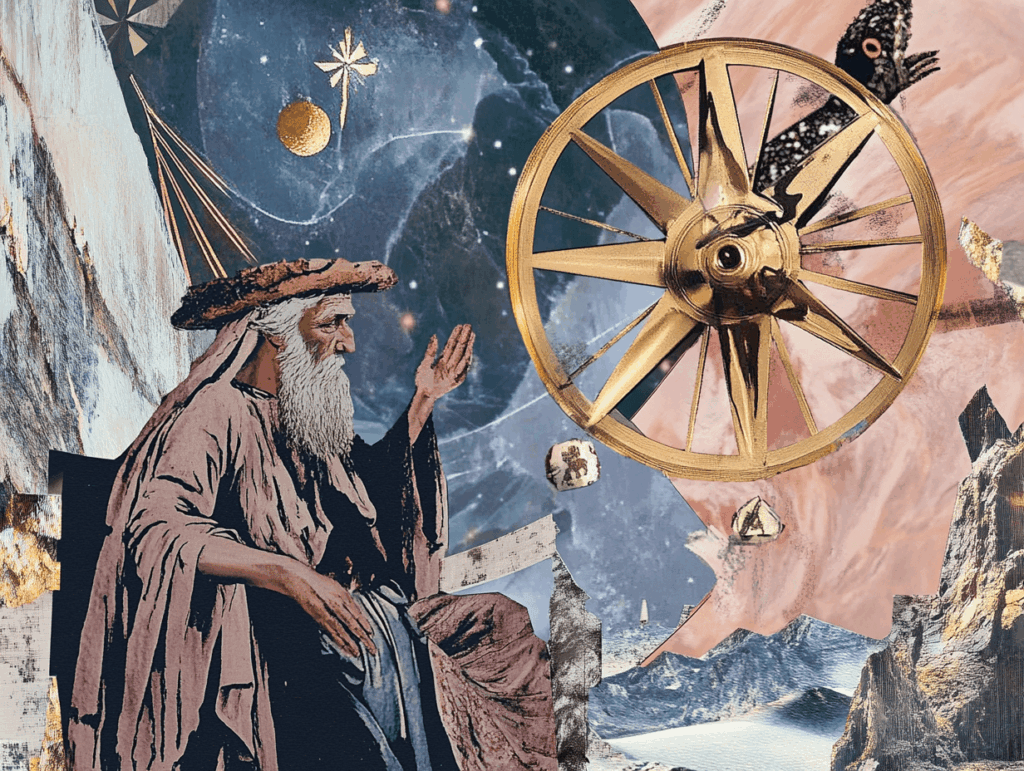
The Wheel of Fortune is the big cosmic spin—the circumstances, timing, and randomness you don’t control. The Hermit is the inner light that decides what any of it means, and how you’ll respond. Your life, Tarot says, isn’t a script or a free-for-all. It’s a dance between the two.
The Wheel of Fortune (X): The Forces You Cannot Control
The Wheel of Fortune is the card that gently reminds you: you are in the universe, not the one running it.
Its keywords are classic: Fate, Karma, Destiny, Jupiter, Cycles. The Wheel covers everything happening in the external world—stuff that doesn’t care about your planner or your five-year goals. Think:
- Job markets shifting.
- The weather ruining your plans.
- Someone choosing to stay, or leave, or ghost entirely.
- A weird stroke of luck that changes everything.
The Wheel spins whether you’re ready or not. Sometimes you’re at the top, feeling lucky and supported. Other times you’re clinging to the edge, wondering when everything will stop moving for five minutes so you can breathe.
The point of this card isn’t to make you feel helpless. It’s to introduce humility—the real kind, not the self-destructive kind. The Wheel says:
You’re one soul in an enormous web of causes and effects.
Things will happen around you, and to you, that you did not choose, could not have predicted, and definitely didn’t “manifest by accident.” That doesn’t mean you failed. It just means you’re alive in a real, messy universe.
When The Wheel of Fortune shows up in a reading, it’s a nudge to zoom out:
- What cycle am I in right now?
- Does this feel like an opening, a turning point, or an ending?
You don’t have to love the answer. But naming it helps. Suddenly it’s not “I’m cursed,” it’s “Oh, I’m in a transition phase. This is a Wheel moment.”
Understand the cycles of destiny with The Wheel of Fortune.
And if your brain loves to spin out on philosophy—Is anything really free will? Is everything predetermined?—just know you’re participating in a debate that’s been going on for centuries. You don’t have to solve it to live your life. Tarot’s job is less “win the argument,” more “help you navigate it without losing yourself.”
The Hermit (IX): The Light You Carry Within
If the Wheel is everything happening “out there,” The Hermit is what’s happening in here.
This card is tied to Introspection, Wisdom, Virgo, Solitude, Guidance. If the Wheel is a stormy sky, the Hermit is the lantern you hold while you walk through it. He can’t control the storm, but he can absolutely choose where he puts his feet.
The Hermit doesn’t pretend to be the main character of the universe. He just takes radical responsibility for his own awareness. He steps away from everyone else’s noise, lifts his light, and asks:
- What is this moment really asking from me?
- What story am I telling myself about what’s happening?
- Is that story actually true—or just familiar?
This is agency in Tarot. Not the fantasy of controlling every outcome, but the very real freedom to decide:
- how you interpret what’s happening,
- how you talk to yourself about it,
- and what you do next.
You can’t stop your landlord from raising the rent or your ex from moving on. You can decide whether you treat that as a confirmation you’re doomed—or as data that something needs to change. That’s Hermit work.
The Hermit is also about meaningful solitude. Not isolation for drama’s sake, but the kind of quiet that lets your own voice come back into focus. A solo walk with no podcast. A journal entry where you stop editing yourself mid-sentence. A night where you pull cards and don’t immediately send a photo to your friend for their take.
The big lesson here: no matter what happens, you get to choose what it means to you.
Find your inner compass with The Hermit.
The Wheel might spin. Life might feel out of control. But as long as you remember there’s a Hermit in you—a part that can step back, breathe, and choose the next right step—you’re not powerless. You’re participating.
Where Justice Fits In: The Bridge Between Fate and Will
We’ve got the Wheel (what happens) and the Hermit (how you respond). Now enter Justice (XI), walking in like, “Okay, but what are you actually doing about it?”
Justice is the law of Cause and Effect in card form. It doesn’t mean “everything is karma” in the oversimplified, blame-y sense. It just says: your choices have consequences. They’re not the only factor, but they’re not irrelevant either.
Think of it as a three-part equation:
- Wheel: Random things happen. A door closes. A door opens. You didn’t fully control it.
- Hermit: You choose your action. You pick the story, the boundary, the next move.
- Justice: That action nudges the next turn of the Wheel. Your choices help shape what’s possible down the line.
Justice doesn’t care about perfection. It cares about alignment. When this card shows up, it often asks:
- Are you acting in integrity with what you say you want?
- Are you taking responsibility for what is yours—without swallowing guilt for things far beyond your control?
That’s the sweet spot: not “it’s all fate, nothing I do matters,” and not “everything is my fault.” Just honest co-creation.
See how your choices create your reality with Justice.
Justice is the bridge between Fate and Free Will. It’s where Tarot says, “No, you didn’t choose the starting conditions. But yes, how you respond from here? That matters.”
“The Serenity Prayer” Tarot Spread (3 Cards)
If you want to actually work with this Fate vs. Free Will thing instead of just thinking about it, here’s a simple spread based on the classic Serenity Prayer:
Grant me the serenity to accept the things I cannot change,
the courage to change the things I can,
and the wisdom to know the difference.
You can use your full deck, or deliberately place The Wheel of Fortune and The Hermit in the first two positions and only pull the third card. Whatever feels right.
Card 1: The Wheel – What is out of my control?
This position is all the external stuff—the Fate piece.
It points to things like:
- systems you’re inside (work, family, culture),
- other people’s choices,
- timing that’s just… timing.
If The Wheel of Fortune literally lands here, that’s your big flashing sign: this is bigger than you. Either way, Card 1 is the weather report. You can’t command the forecast, but you can acknowledge it.
Question to sit with: What am I currently trying to control that isn’t actually mine to manage?
Card 2: The Hermit – What is within my control?
Here’s where your agency lives.
This card shows your levers:
- your mindset and self-talk,
- your boundaries,
- your willingness to ask for help,
- the small actions you can take.
If The Hermit shows up literally, it’s a strong call to step back, listen inward, and move from a more truthful place.
Ask yourself: Given Card 1, what is mine to do—or to stop doing?
Card 3: The Wisdom – How do I navigate the difference?
Card 3 is the “wisdom to know the difference” piece. It’s the bridge between Fate and Free Will, giving you a practical way to live with both.
It might be telling you to:
- stop fighting something that’s already in motion,
- take one specific, brave step,
- tell the truth (even if just to yourself),
- rest before deciding,
- or reframe the story you’ve been telling about what’s happening.
Read Card 3 as your navigation instructions: how to move through this moment without collapsing into helplessness or hyper-control.
Conclusion
Tarot doesn’t say your future is set in stone. It also doesn’t hand you the crown and say you rule the universe.
You are not a victim of the cards.
You are not the god of them, either.
You are the navigator—someone moving through a world shaped by countless forces you’ll never fully control, carrying a lantern of awareness that’s completely yours.
The Wheel of Fortune reminds you that life will always contain mystery, randomness, and cycles you didn’t choose. The Hermit reminds you that your inner world and your responses are still your domain. Justice steps in to say your choices, however small they seem, actually matter.
You don’t have to solve the Fate vs. Free Will debate to live a meaningful life. You just have to keep showing up: noticing the season you’re in, listening to your own wisdom, and choosing the next honest step.
So try this right now, if you’re curious:
Pull “The Wheel” position right now.
What external force is spinning in your life today—and how do you want to meet it?
